Bongeunsa Temple
奉恩寺A 1,200-year-old temple facing the COEX towers
Bongeunsa is a mountain temple set right in the middle of Gangnam, facing the high-rise towers of COEX and the World Trade Center. It sits so close to the city that the temple gate stands just outside Exit 1 of Bongeunsa Station on Subway Line 9 — and its charm is the sudden shift from a walk among glass skyscrapers into wooden halls and pine trees. Founded in the Silla era and once a prosperous royal temple of the Joseon court, this 1,200-year-old temple is still very much alive today, with its giant Maitreya Buddha and its temple-stay program.
📖 The Story
Bongeunsa traces its roots to Gyeonseongsa, founded in 794 (the 10th year of King Wonseong of Silla) by the monk Yeonhoe. When Seolleung, the royal tomb of King Seongjong of Joseon, was laid out nearby, Queen Jeonghyeon in 1498 greatly rebuilt Gyeonseongsa as a temple to pray for the late king's soul and renamed it Bongeunsa. As a guardian temple that tended the royal tomb and held memorial rites, Bongeunsa became a temple bound closely to the Joseon royal house.
Bongeunsa steps onto the stage of history in the reign of King Myeongjong (1545–1567). Queen Munjeong, ruling as regent for the boy-king, appointed the monk Bou as abbot of Bongeunsa in an effort to revive Buddhism in an age when the state suppressed it. The two Buddhist orders were re-established in 1550, and in 1552 the seunggwa — the state examination for monks — was revived; its examination ground, Seunggwapyeong, lay on what is now the COEX district. Through this examination emerged Hyujeong (Seosan Daesa) and Yujeong (Samyeong Daesa), the monks who led warrior-monk armies during the Imjin War — making Bongeunsa the very heart of the Joseon Buddhist revival.
Bongeunsa also left its mark on the history of Joseon art. The plaque reading 'Panjeon,' written by the calligraphy master Kim Jeong-hui (Chusa) in 1856 — just three days before his death — hangs here and is said to be his very last work. Panjeon is the hall that houses the printing woodblocks of the Avatamsaka Sutra commentary. Today Bongeunsa welcomes Korean and foreign visitors alike through its temple stay and lantern festival, all beneath the roughly 23-meter Mireuk Daebul (Maitreya Buddha), completed in 1996, that gazes out over the city.
✦ Highlights
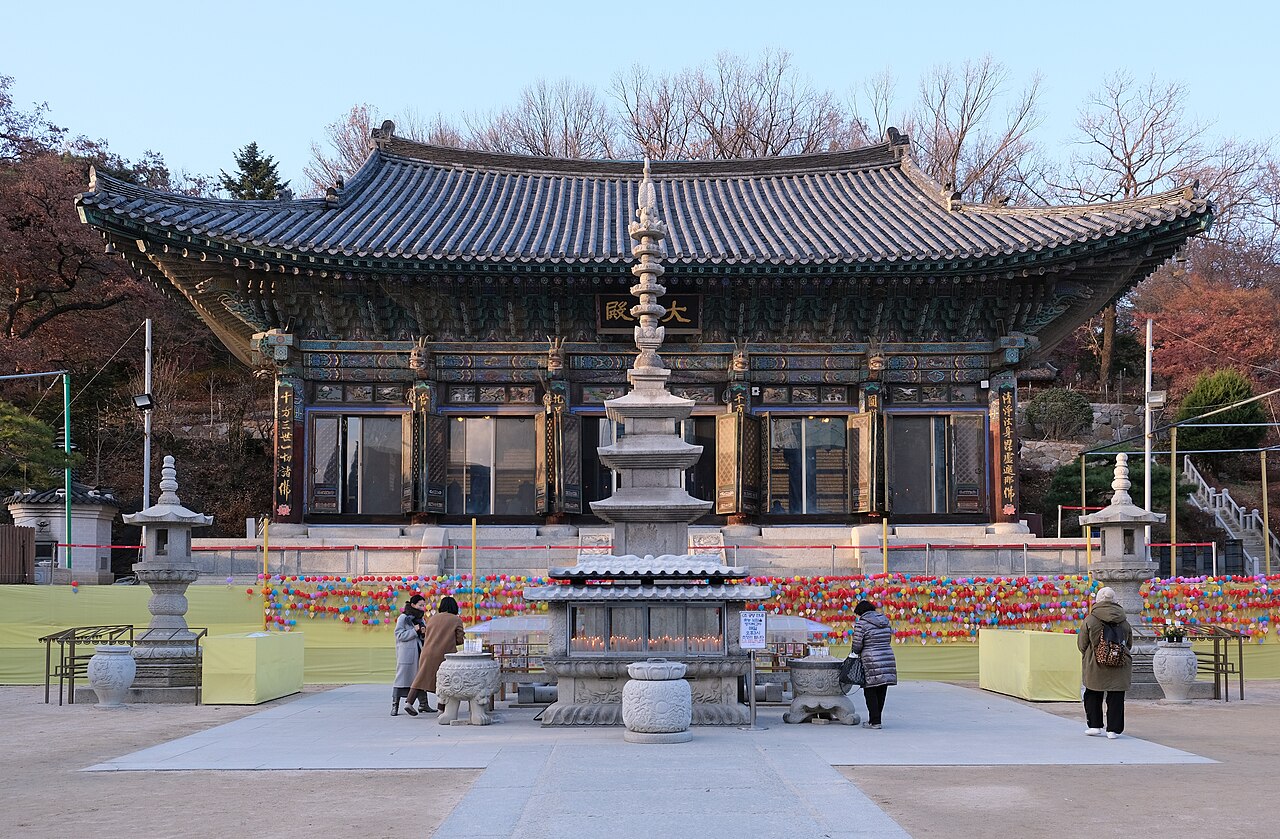
- ›Daeungjeon (Main Hall)The temple's central worship hall; its painted eaves and wooden frame, backed by a pine grove, stand in striking contrast to the Gangnam skyline behind it.
More
Inside sits a wooden Shakyamuni Buddha triad carved in 1651 under the master sculptor Seungil — a masterpiece of late-Joseon Buddhist sculpture, designated a national Treasure in 2014. Circle the three-story pagoda and stone lantern in the courtyard, then look up at the sweeping hip-and-gable roofline from the bottom of the steps. During morning and evening services, chanting and the beat of the moktak drift across the courtyard, and for a moment you forget this is the middle of Gangnam.
- ›Panjeon and Chusa's PlaqueThe hall that stores the woodblocks of the Avatamsaka Sutra, bearing the 'Panjeon' plaque — the final work of the calligrapher Kim Jeong-hui, written three days before he died.
More
Built in 1856, Panjeon is the oldest building on the grounds (a Seoul Tangible Cultural Heritage). The monk Namho Yeonggi copied out all eighty volumes of the Avatamsaka Sutra commentary by hand and had them carved onto woodblocks — this hall was built to house them. Beside the name plaque is a small inscription reading 'written in sickness at seventy-one'; many consider its artless, almost childlike strokes the final summit of Kim Jeong-hui's calligraphy.
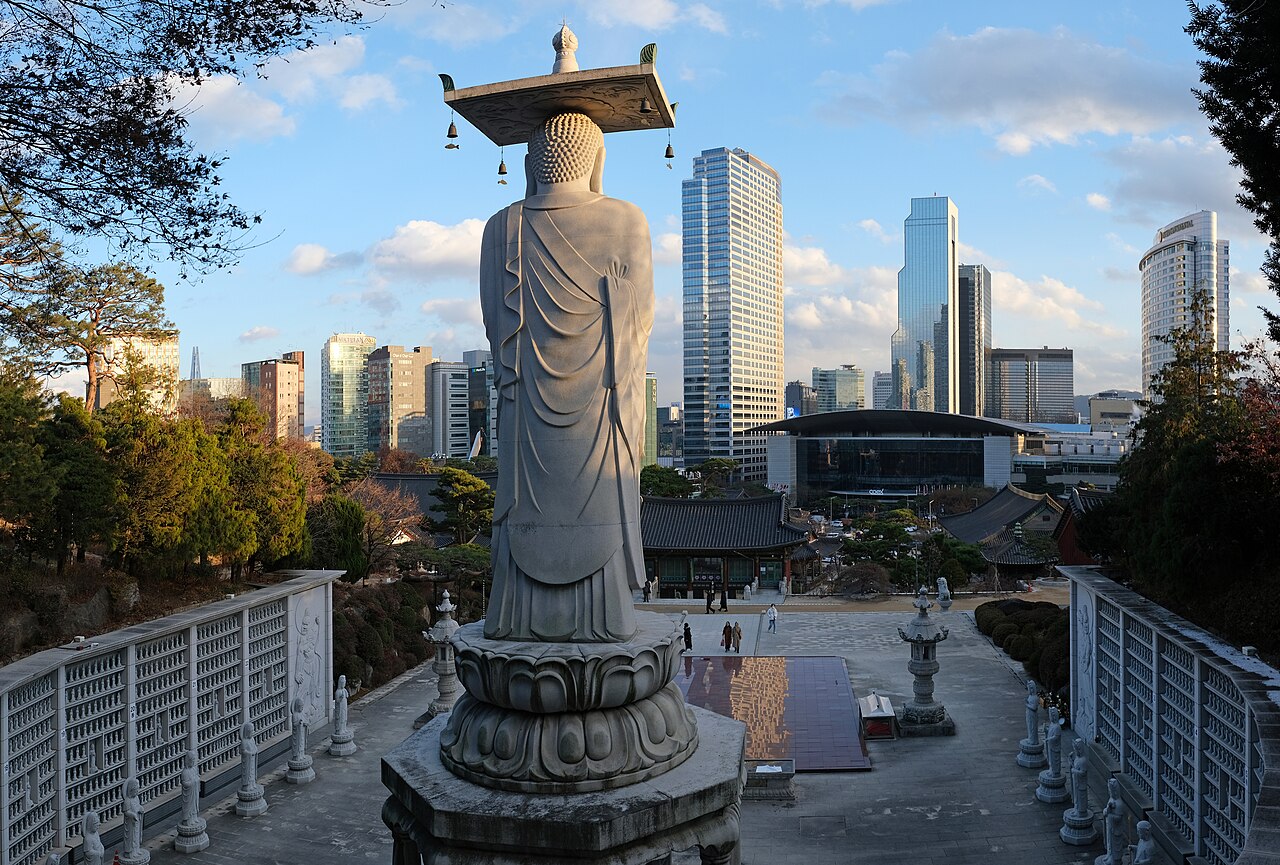
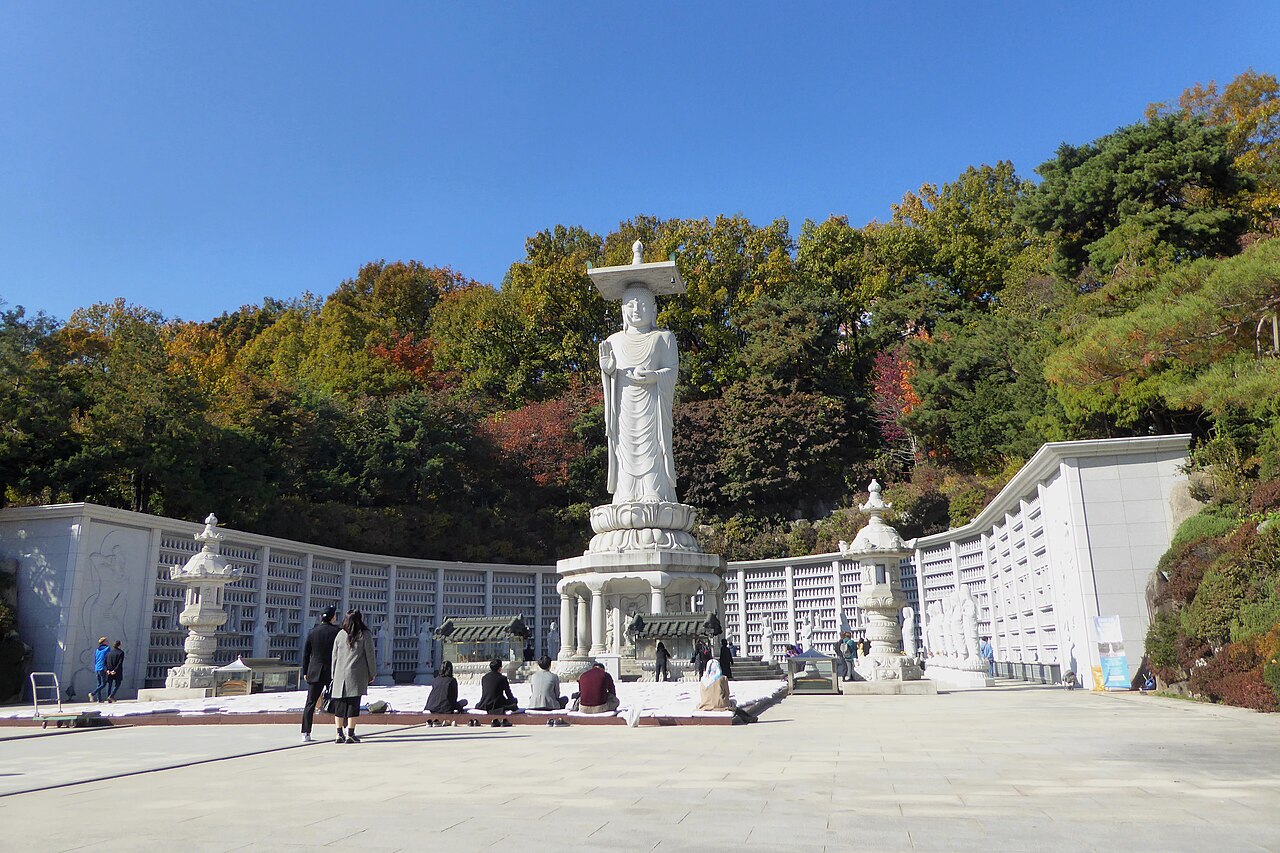
- ›Mireuk Daebul (Maitreya Buddha)A standing stone statue of the Maitreya Buddha about 23 m tall, completed in 1996 — among the largest stone Buddhas in Korea — looking out over the city.
More
Vowed in 1986, the statue took some ten years of work before its completion. The plaza at its feet is an open-air prayer ground, where bowing worshippers and travelers share the same space — a scene unique to this spot. Afternoon light falling on the south-facing figure makes for the best photos, and after dark the statue is lit up, blending with the office lights behind it into an entirely different night view.
- ›City Skyline View and Temple StayFrom points around the grounds, the COEX and World Trade Center towers frame the temple halls in a single view, and an overnight temple stay lets you experience a mountain temple in the heart of the city.
More
Temple-stay programs are built around seated meditation, tea with a monk, and joining the dawn service, with sessions for foreign visitors as well (book ahead on the website). Around Buddha's Birthday in May the grounds fill with lotus lanterns, making an evening walk especially beautiful. If an overnight stay feels like too much, simply finding the spot where the skyline rises over the tiled roofs, taking a photo, and continuing onto the Sudosan meditation trail easily fills half a day.
🚶 Self-Guided Walk
- 1Jinyeomun GateThe temple's front gate. 'Jinyeo' means 'true suchness' — passing through it symbolizes stepping into the Buddha's world. You can feel the noise of the high-rise district fade the moment you cross it.💡 It is right in front of you as you leave Exit 1 of Bongeunsa Station (Line 9).
- 2Beopwangnu PavilionThe great pavilion between the front gate and the main hall — its name means 'where the King of Dharma dwells.' Beyond it opens the main courtyard with its three-story stone pagoda.
- 3Daeungjeon and the CourtyardThe temple's central worship hall. Take your time with the stone pagoda, the lanterns, and the painted eaves — then turn around: the Gangnam skyline hangs right above the tiled roofs.💡 The signature photo spot — traditional tiled roofs and skyscrapers in a single frame.
- 4Mireuk Daebul (Great Maitreya Buddha)The roughly 23-meter stone Buddha on the hillside behind the main hall, facing south over the city. Stand in the memorial plaza at its feet and look up — the scale is best felt from below.💡 From the terrace beside the statue, the COEX and Trade Tower skyline lines up behind the Buddha — the angle of this page's cover photo.
- 5Panjeon HallRight beside the great Buddha stands the oldest building on the grounds (a Seoul Tangible Cultural Heritage). It houses the Avatamsaka Sutra woodblocks, and its name plaque is the very last calligraphy of Kim Jeong-hui, written three days before his death.💡 Look for the small seal inscription beside the plaque — it reads 'written in sickness at seventy-one.'
- 6Sudosan Meditation TrailA forest path on the slopes of Sudosan that wraps around the temple grounds (opened in 2021). Finish your walk with a loop that looks down over the halls from above.
🧭 Visitor Info
💡 Good to Know
- Allow 40 minutes to an hour for the grounds, or about an hour and a half if you add the meditation trail.
- Take off your hat and leave your shoes by the door when entering a worship hall. Avoid photographing inside halls during services, but the outdoor grounds are free to shoot.
- Around Buddha's Birthday in May the grounds fill with lotus lanterns, and autumn colors around the great Buddha are superb. For a quiet visit, go early in the morning.
- Temple-stay programs run from day sessions to overnight stays, including programs for foreigners — book in advance on the temple's website.
🗺 Pair Your Visit
Bongeunsa was the base from which the monk Bou led a Buddhist revival under Queen Munjeong in King Myeongjong's reign; the re-establishment of the two Buddhist orders in 1550 and the revival of the monk examination in 1552 are frequent exam topics. Along with Seosan Daesa and Samyeong Daesa, who passed that examination, it is a key to understanding early-Joseon Buddhist policy.