Gamcheon Culture Village
A hillside built by war refugees, reborn in color
Gamcheon Culture Village is a settlement in Busan's Saha-gu district where houses climb a steep hillside in stacked tiers, like steps. Refugees of the Korean War (1950–53) took shelter on this slope, and in 1955 believers of Taegeukdo, a new religious movement, relocated here en masse and gave the village its shape — which is why it was known for decades as Taegeukdo Village. In 2009 a public-art project filled the alleys with murals and sculptures and painted the houses in bright colors, giving the village its present name and face; today two to three million people visit each year, making it one of Busan's signature sights. But it is a lived-in neighborhood before it is a viewpoint, and that fact should shape how you walk it.
📖 The Story
Gamcheon began with a war. When the Korean War broke out in 1950 and Busan became the wartime capital, people pushed to the southern tip of the peninsula found no room in the city center and climbed the hillsides instead. What fixed the settlement in place was 1955. Taegeukdo, a new religious movement in the Jeungsan tradition, had moved its headquarters to Busan's Bosu-dong under its leader Jo Cheol-je in 1948, and in 1955 its followers relocated together into the Gamcheon valley and the village took form. The plan called for 3,000 households and more than 10,000 people, but by most accounts about 800 households and some 4,000 people actually made the move. That is why the village was known for so long as Taegeukdo Village.
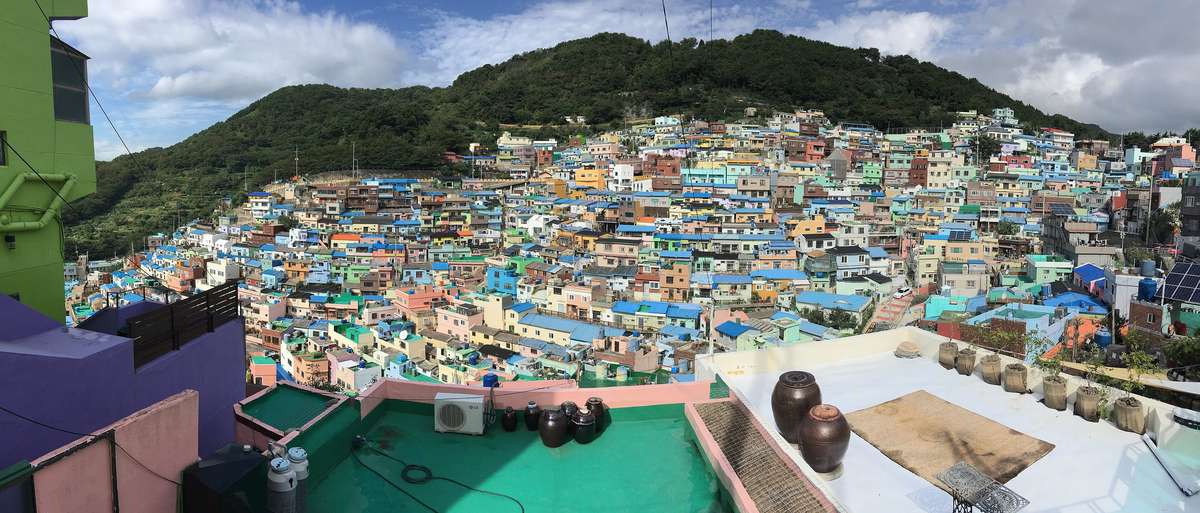
There was a rule to how the houses were placed on the slope: each one was set slightly off from the one below so that no house would block the view or the light of the house behind it, producing the stepped tiers you see today. The principle is said to have been laid down by Taegeukdo's leader, though this belongs more to village lore than to documented record. Either way, the result is visible at a glance — a stacked structure in which no roof steals the sky from the house above it, threaded by narrow alleys and stairways that run between the homes like capillaries. Among Busan's sanbok-doro landscapes, the hillside neighborhoods that grew along roads cut across the mountainsides, Gamcheon preserves that original form on the largest scale.
The village became a destination in 2009. A public-art project titled "The Machu Picchu of Busan, Dreaming" brought in the design department of Dongseo University to fill the alleys with murals and sculptures, and in February 2010 it was selected for the Ministry of Culture, Sports and Tourism's content-convergence tourism program, formally becoming a "culture village." A follow-up, the Machu Picchu Alley Project, added ten more installations in 2012. The outcome has been a success and a burden at once. Visitor counts vary widely between sources — somewhere in the range of two to three million a year — with roughly 2.76 million recorded for 2023, about 60% of them foreign visitors. In 2022 the press reported that the number of tourists per resident here had reached 53 times that of Venice, a textbook overtourism figure. To walk Gamcheon today is to share a village built by war with the people who still live in it.
✦ Highlights
- ›The Stacked Hillside ItselfThe first thing to look at in Gamcheon is not any single installation but the village itself. Face the far side of the valley and you see blue, green, and pink roofs stepping up the slope in offset tiers, with alleys and stairways running between them like drawn lines.
More
The stepped structure was built for living, not for looks. Village tradition holds that houses were deliberately offset so that no home would block the view or daylight of the one behind it, and the result is that no roof entirely shuts out another's sky. The color came much later, after the 2009 public-art project. What you are looking at, in other words, is the skeleton of 1950s refugee housing with a twenty-first-century coat of paint on top — hold both layers in mind and the photograph means something different.
- ›The Little Prince and the FoxThe Little Prince and his fox, seated on the railing along Gamnae 2-ro, is the most popular photo spot in the village. Behind their backs the whole hillside opens across the valley, putting figure and landscape in a single frame.
More
Murals and installations are scattered through the alleys, added by the 2009 public-art project and the 2012 Machu Picchu Alley Project, which contributed ten more works; this one is by far the most photographed. Its popularity means long queues through the middle of a busy day, so aim for early morning or late afternoon. Remember, too, that the spot sits on a lane residents use to get home: queue to one side so people can pass, and don't linger once your turn comes.
- ›Haneulmaru ObservatoryA lookout above the village with a clear line of sight toward Gamcheon Harbor and the port of Busan. Down in the alleys you see only roofs and walls; from here the village reads as one picture, together with the sea.
More
The lookout is where it becomes clearest why Gamcheon exists at all. The harbor lies below the slope and the mountain closes it off behind — this terrain is what refugees found when, shut out of the city center, they climbed to the nearest empty ground that was still within reach of the water and of work. Most routes up are stairs and gradients, so it is easiest to save this for last, when you know how much walking you have left in you.
- ›The Lighthouse Photo PointA photo point known as "the lighthouse," set up so that it frames the village like a picture. It draws smaller crowds than the Little Prince spot, so you can take your time here.
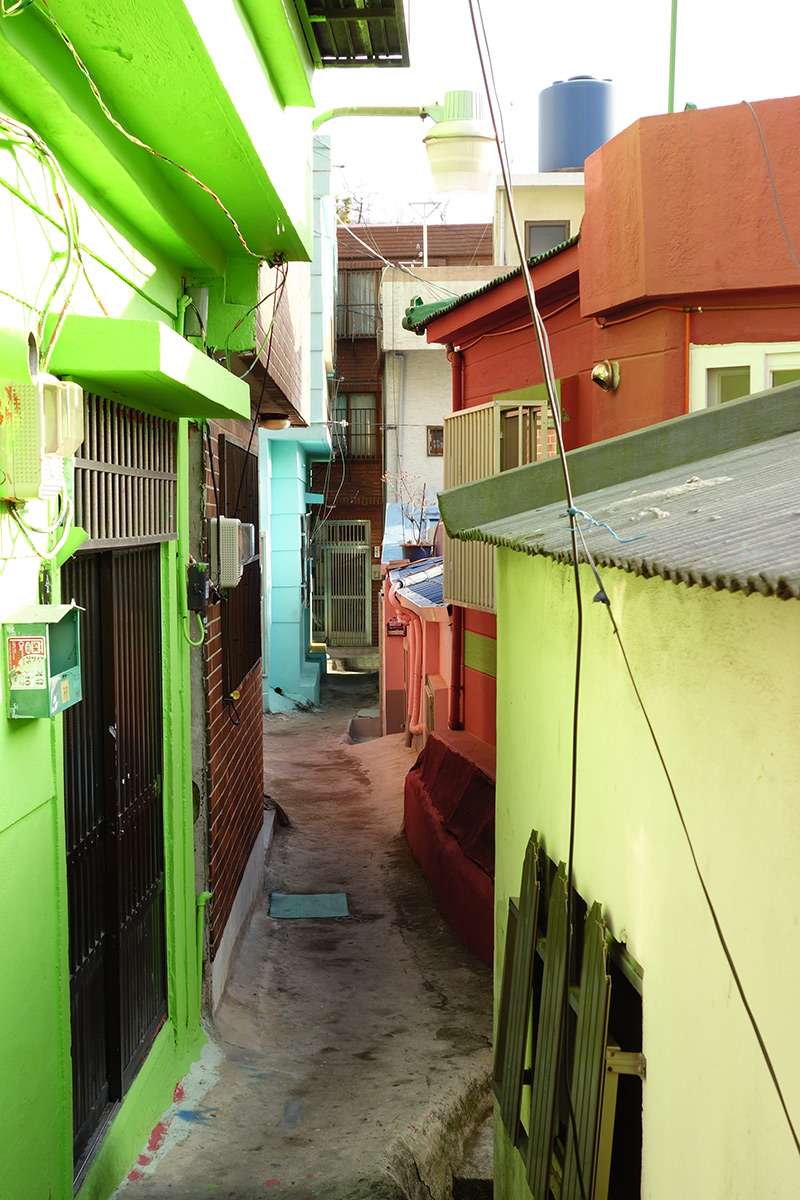
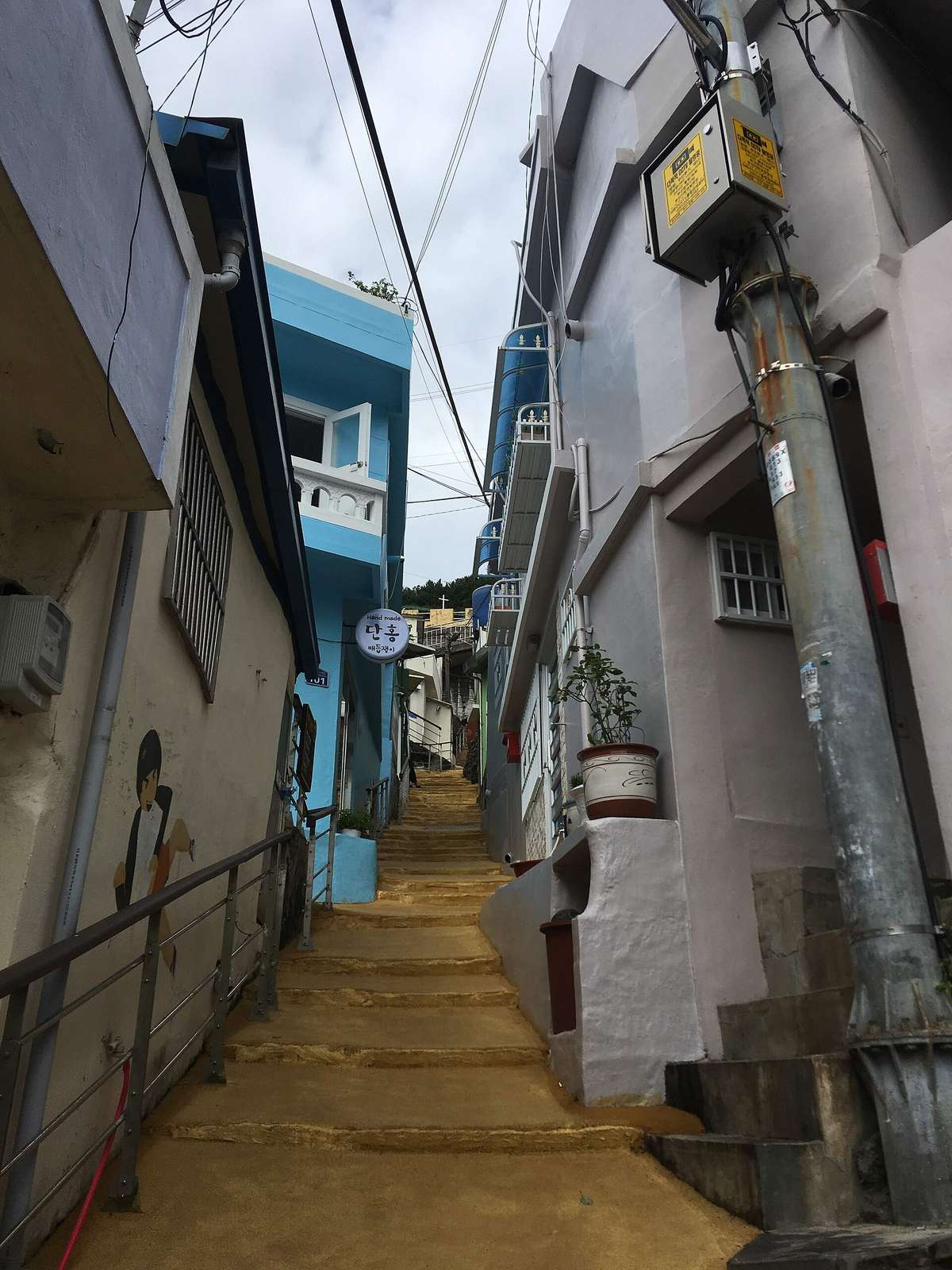
- ›The Alleys, the Stairs, and the Stamp MapGamcheon's real face is not the lookout but the alleys barely wide enough for one person and the steep flights of steps between them. Pick up the stamp map sold at the information center and collect the stamps at nine spots around the village, and those alleys become your route.
More
The stamp map costs 2,000 won at the information center at 203 Gamnae 2-ro, and filling all nine stamps earns you a village postcard. Follow the map you are given on site for the order of the stops. There is one rule for walking the alleys: this is housing, not an exhibition. Don't photograph windows or yards, don't look through gateways, and keep your voice down. On the narrow stairs, give way to anyone coming up and to residents carrying loads — that is simply how it is done here.
🚶 Self-Guided Walk
- 1Toseong Station Exit 6 → village busLeave Toseong Station on Line 1 by Exit 6 and take village bus Saha 1-1, Seo-gu 2, or Seo-gu 2-2 up to the village. From Goejeong Station's Exit 6, buses Saha 1 and Saha 1-1 also serve it.💡 The village is one long run of steps and slopes — proper walking shoes are effectively required.
- 2Gamcheon Culture Village Information CenterThe information center at 203 Gamnae 2-ro is the practical starting point. Buy the stamp map here (2,000 won) and you have a route through the village's nine designated stops.💡 Complete all nine and you get a village postcard. Follow the map handed to you on site for the order of the stops.
- 3The Little Prince and the FoxWalk along Gamnae 2-ro and you reach the Little Prince and his fox perched on the railing — the village's most popular photo spot, with the whole opposite hillside filling the frame behind them.💡 Expect a queue in peak hours — and line up on the side that leaves the lane clear for residents.
- 4The Lighthouse Photo PointA photo point framed to hold the village like a picture. It is quieter than the Little Prince spot, so if the queue there defeated you, this is where you get your shot.
- 5The alleys and stairwaysStep one layer in from the main lane and you are in alleys barely wide enough for one person, linked by steep flights of steps. This is where the offset arrangement of the houses — each set so as not to block the one behind — stops being a description and becomes something you feel.💡 Every door here is someone's home: don't photograph windows or yards, and on the narrow stairs let residents pass first.
- 6Haneulmaru ObservatoryThe lookout above the village, with the view opening toward Gamcheon Harbor and the port of Busan. It is uphill, so keep it for last while you still have the legs for it.
🧭 Visitor Info
💡 Good to Know
- Allow roughly an hour and a half to two hours to make the loop, if you are collecting all nine stamps. The whole village is on a slope, an unbroken sequence of stairs and climbs, so come in comfortable shoes and don't schedule it tight.
- Gamcheon is a residential neighborhood first and a sight second. Keep your voice down, never step onto private property or photograph windows and yards, and give way to residents on the narrow stairs — that is the basic etiquette here.
- Between 10:00 and 15:00 at weekends, tour coaches arrive in numbers and the alleys are at their most crowded. Come early in the morning or late in the afternoon and you will photograph without queueing — and intrude less on the residents' day.
- In response to overtourism, Saha-gu district has been pursuing a plan to designate Gamcheon a special management zone with restrictions such as limited visiting hours (as of late 2024; whether it has taken effect is unconfirmed). Check the official site (gamcheon.or.kr) or the information center for the current position before you go.
🗺 Pair Your Visit
Gamcheon Culture Village is a piece of terrain that still testifies to Busan's role as the wartime capital during the Korean War (1950–53). It preserves the distinctively Busan sanbok-doro landscape formed when refugees shut out of the city center climbed the hillsides, and its framework was set by the mass relocation of Taegeukdo believers in 1955. Note, however, that Gamcheon is not among the nine components of "Sites of the Wartime Capital Busan during the Korean War," added to Korea's UNESCO tentative list in May 2023 (Gyeongmudae, the Ami-dong Grave Village, the Uam-dong cattle sheds, and others). Read it alongside them as refugee housing of the same period and the same character — but do not confuse it with the listed sites.