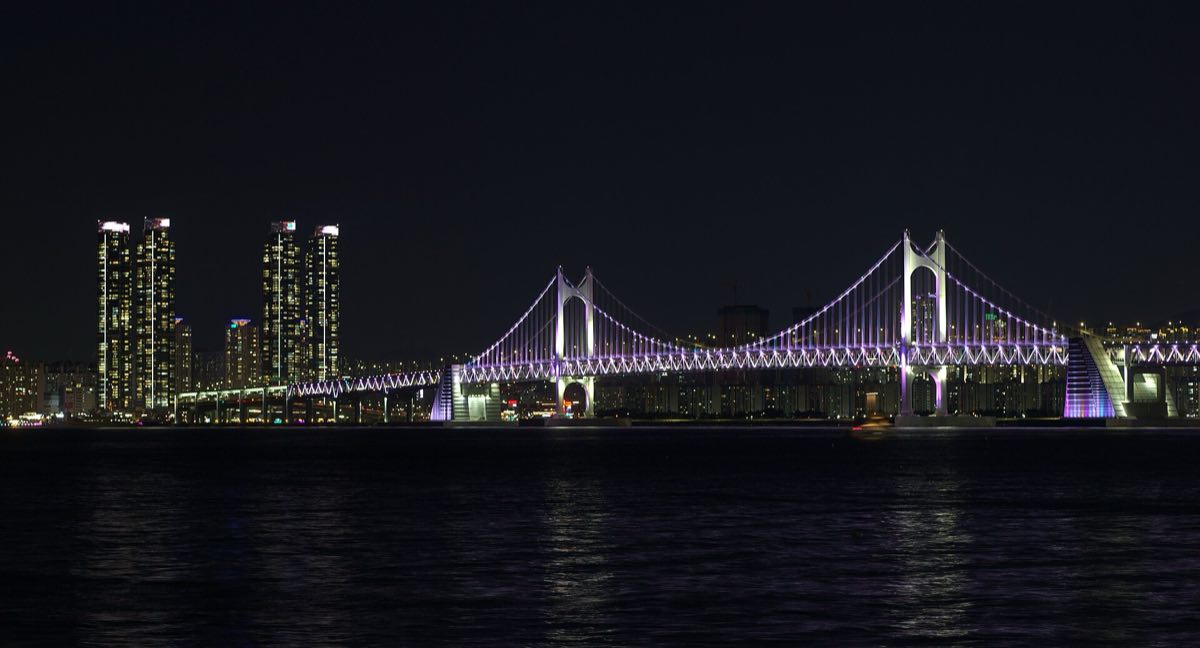
Gwangalli Beach and Gwangan Bridge
A 7.4-kilometer bridge across the bay — and drones in the sky on Saturday nights
Gwangalli is the Busan beach where the sea and the city skyline share a single frame. Straight out from the sand, the 7.42-kilometer Gwangan Bridge stretches clear across the bay, and after sunset its full length lights up in more than a hundred thousand colors. Every Saturday evening some 1,100 drones rise into the sky above it for a free light show. And the old name of this district — Suyeong, literally 'naval headquarters' — marks the ground where the Joseon navy's eastern command once stood, so the memory of the Imjin War lies beneath one of Korea's most photographed night views.
📖 The Story
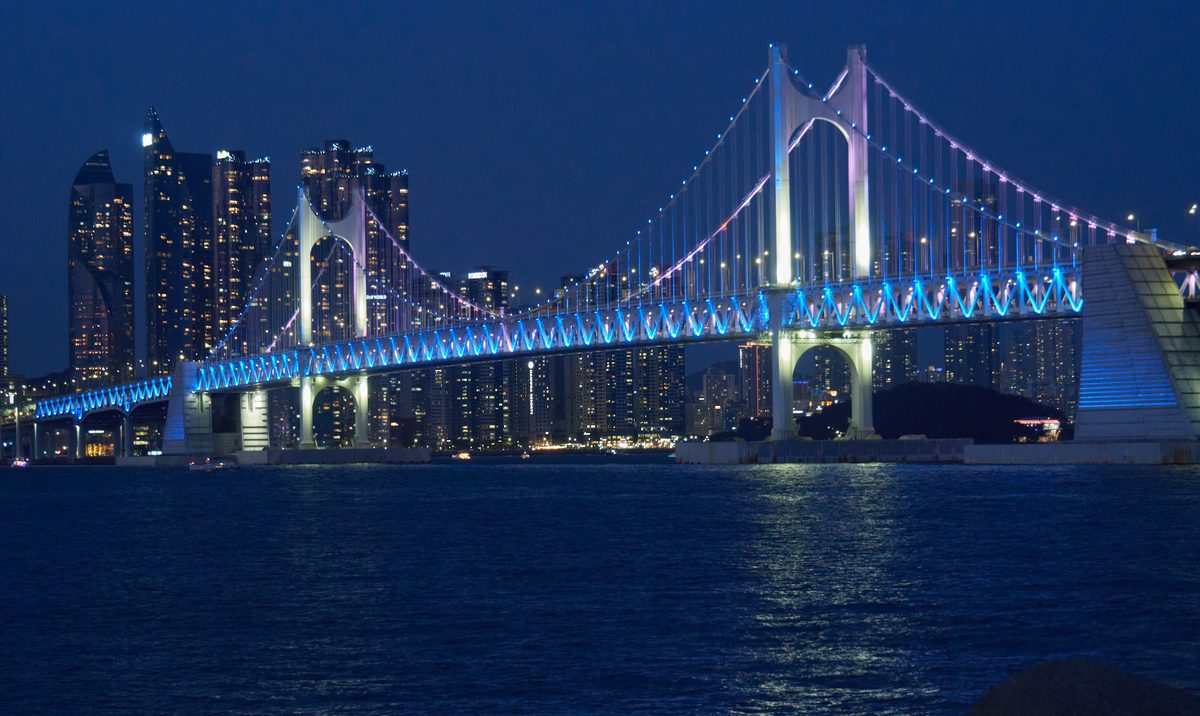
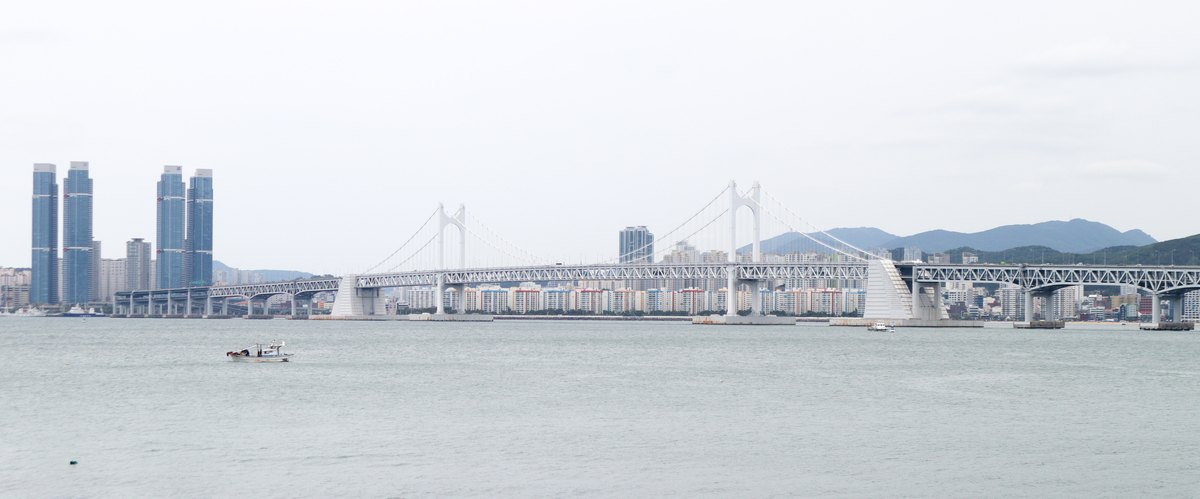
Work on Gwangan Bridge began in December 1994; it opened provisionally for the 2002 Busan Asian Games and was fully inaugurated on 6 January 2003. Running from Namcheon-dong across the water to Centum City, it is a 7,420-meter double-deck sea crossing carrying eight lanes of traffic on two levels. People often call it a suspension bridge, but strictly speaking only the 900-meter central span hangs from cables between towers — the rest is a long run of truss and deck spans over the sea. At night, lighting capable of more than a hundred thousand colors washes the entire structure, which is how it earned its English nickname, the Diamond Bridge (its official English name is simply Gwangan Bridge).
The district that holds both the bridge and the beach is called Suyeong-gu. 'Suyeong' is a contraction of sugun jeoldosa-yeong — the headquarters of a naval commander — meaning this was the seat of a Joseon naval command. Joseon divided the waters off Gyeongsang Province into a Left and a Right Naval Command, and from 1652 onward, through the rest of the Joseon period, the main base of the Gyeongsang Left Naval Command, which guarded the seas off Busan, stood here. Today the streets are lined with apartments and cafés, but the place name itself survives as a trace of that naval garrison.
When the Imjin War broke out in 1592, Bak Hong, commander of the Gyeongsang Left Naval Command, abandoned the fortress and fled. What remained were twenty-five men — sailors and townspeople — who went on fighting along this shore for the seven years of the war. In 1609 the magistrate of Dongnae, Yi An-nul, heard their story and honored them with two characters, uiyong, meaning 'righteous courage'; in 1853 a shrine, the Uiyongdan, was raised in their memory. The Shrine of the Twenty-Five Uiyong was designated a Busan Monument in 1972 and stands today inside Suyeong Historic Park, laid out in 1995, alongside the remains of the naval fortress and its south gate. In the park a black pine (Natural Monument No. 270) and a muku tree (No. 311) have stood for centuries, and there is also a shrine to An Yong-bok, who defended Ulleungdo and Dokdo.
✦ Highlights
- ›Gwangan BridgeA 7.42-kilometer double-deck bridge running across the bay right in front of the beach. After sunset the whole span lights up, and it becomes the centerpiece of the Gwangalli night view.
More
It runs from Namcheon-dong to Centum City as a two-level structure, with eight lanes of traffic split between the upper and lower decks. You can drive across, but there is no pedestrian walkway — the place to admire the bridge itself is the beach. And it is not a suspension bridge end to end: only the 900-meter central section hangs from cables, so from the sand you see a single sweeping curve between the two towers with long straight decks running out to either side. That contrast is what makes Gwangan Bridge instantly recognizable in photographs.
- ›Gwangalli M Drone Light ShowEvery Saturday evening, around 1,100 drones draw pictures in the night sky above Gwangan Bridge — a free show lasting about twelve minutes.
More
The show runs twice a night — at 20:00 and 22:00 in the summer season (March–September), and at 19:00 and 21:00 in winter. There are no seats and no tickets: you simply look up from anywhere along the beach, so arriving on the sand twenty to thirty minutes early is plenty. Themes and cancellations change often with the weather and the event calendar, so it is worth checking the official notice (gwangallimdrone.co.kr) on the day you go.
- ›Gwangalli Beach and Millak Waterfront ParkCafés and restaurants line the beachfront, and at the eastern end Millak Waterfront Park offers wide seaside decks facing straight out at the bridge.
More
The swimming season generally runs from early July to late August (dates vary by year), but the beach walk and the night view are there in every season. Millak Waterfront Park has broad decks laid out toward the water, ideal for sitting with the bridge dead ahead — though rules on food and alcohol there change from time to time, so check the on-site signs. Walk slowly from the western end of the sand east toward Millak-dong and the angle of the bridge keeps shifting as you go.
- ›Suyeong Historic Park and the Shrine of the Twenty-Five UiyongLaid out as a park in 1995 on the site of the Gyeongsang Left Naval Command, with the fortress's south gate, the shrine to the Twenty-Five Uiyong, and centuries-old protected trees.
More
Inside the park stands the shrine built in 1853 for the twenty-five men who stayed behind and fought on for seven years after the naval commander abandoned the fortress in 1592 (designated a Busan Monument in 1972). They were not an organized militia but sailors and townspeople who remained at the fortress, which is why they are remembered as uiyong — 'the righteous and brave' — rather than as righteous-army soldiers. The old black pine here is Natural Monument No. 270 and the muku tree No. 311, and a shrine honors An Yong-bok, defender of Ulleungdo and Dokdo. It is one subway stop from Gwangalli, so a history-minded visitor may prefer to come here in the morning and head to the beach in the afternoon.
🚶 Self-Guided Walk
- 1Geumnyeonsan Station, Exit 3The closest subway exit to the sand on Line 2. Walk down the side streets for about five minutes and the sea opens up between the buildings.💡 The name tempts you toward Gwangan Station, but Geumnyeonsan is the closer stop for the beach.
- 2Gwangalli BeachFace the water and the bridge cuts straight across the horizon. The best walk is a slow one from the western end eastward, watching the angle of the span change as you go.💡 To fit the whole bridge in one frame, walk down to the waterline around the middle of the beach.
- 3Millak Waterfront ParkA deck park on the water at the eastern end of the beach. It faces the bridge head-on and up close — the place to be when the lights come on at dusk.💡 Rules on food and alcohol here change from time to time — check the on-site signs.
- 4If it's Saturday — the Drone Light ShowIf it is a Saturday evening, stop here and look up: about 1,100 drones rise above the bridge for a twelve-minute performance. It is visible from anywhere on the beach, so there is no need to move.💡 Confirm the start time and whether it is running on the official notice page (gwangallimdrone.co.kr) that day.
- 5On to Suyeong Historic ParkOne stop on Line 2: from Exit 1 of Suyeong Station it is a short walk to the park holding the ruins of the Gyeongsang Left Naval Command and the shrine of the Twenty-Five Uiyong — a Gwangalli from an entirely different century than the one on the beach.💡 If history is your priority, reverse the route: see the historic park in the morning and finish with the beach at sunset.
🧭 Visitor Info
💡 Good to Know
- The station name suggests Gwangan, but the closest stop to the sand is Geumnyeonsan on Line 2 — about a five-minute walk from Exit 3. From Gwangan Station, Exits 3 and 5, it takes 10–15 minutes.
- The drone show is free and runs twice every Saturday evening (20:00 and 22:00 from March to September, 19:00 and 21:00 in winter) for about twelve minutes. Themes and cancellations change often, so check the official page (gwangallimdrone.co.kr) on the day.
- You cannot walk across Gwangan Bridge. To see the view from the bridge you have to drive or take a bus over it — but for taking in the bridge itself, the beach and Millak Waterfront Park are far better.
- The swimming season usually runs from early July to late August, shifting slightly each year. The beach walk and night view are available all year, so an off-season visit with fewer crowds is a fine option.
🗺 Pair Your Visit
The place name Suyeong is short for 'naval commander's headquarters' — the main base of Joseon's Gyeongsang Left Naval Command stood here. Together with the story of the Twenty-Five Uiyong, the sailors and townspeople who fought on after their commander abandoned the fortress in the Imjin War of 1592, the site connects to Korean History Exam topics on the Joseon naval command structure and the opening stage of the war.