Haeundae Beach
The Busan beach that a Silla scholar named eleven centuries ago
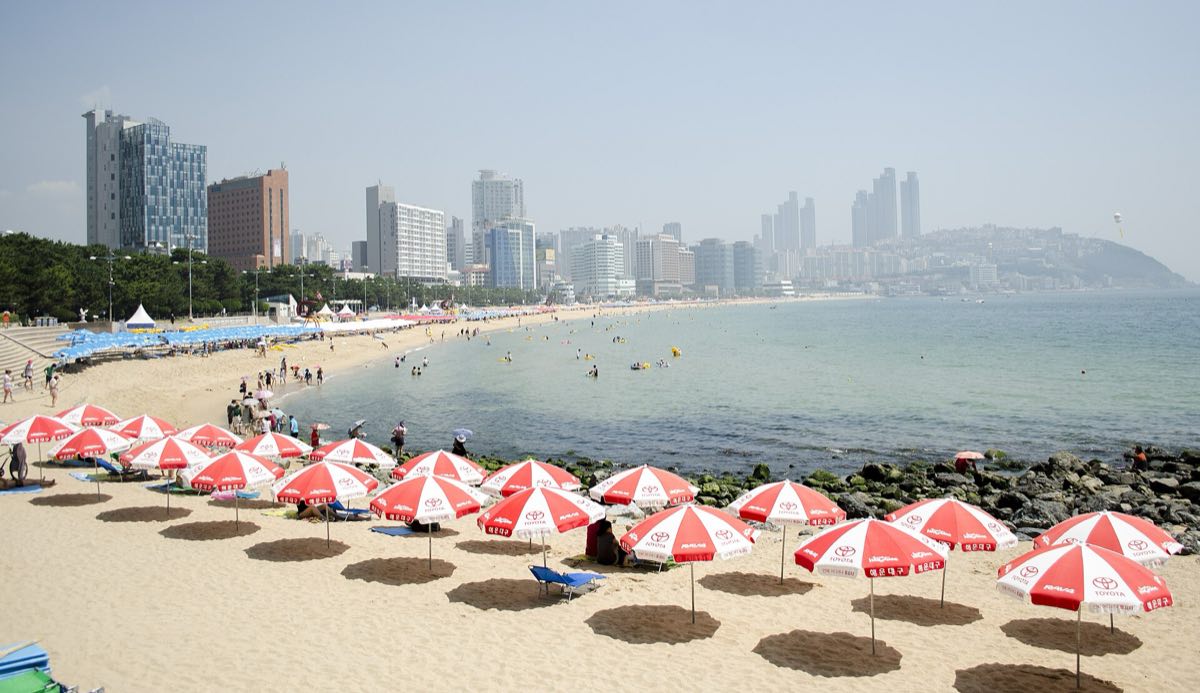
Haeundae is Busan's signature beach — a stretch of sand about 1.5 km long and 70 to 90 m wide. High-rise towers stand behind it like a folding screen, while at its western end Dongbaek Island, thick with camellia trees, juts into the sea, so that city and nature share a single frame. The name is said to come from Choe Chi-won, a scholar of late Silla, and the three characters 海雲臺 carved into a rock on Dongbaek Island survive as the evidence. In midsummer parasols cover the sand end to end, but the beach and the island's shoreline path stay open in every other season too.
📖 The Story
The name Haeundae is said to come from Choe Chi-won (857–?), the great writer of late Silla. 'Haeun' (海雲, 'sea cloud') was another of his names — most records pass it down as his courtesy name, his literary name being Goun (孤雲, 'lonely cloud'). The story goes that, struck by the scenery as he passed along this shore, he carved the three characters 海雲臺 into a rock on Dongbaek Island, naming the place after himself. That inscription still sits beside the island's walking path today and is designated a Busan Monument. Whether the brushwork is truly his cannot be confirmed, but the Goryeo poet Jeong Po wrote of the carving in verse, so the characters were certainly on the rock by Goryeo times. Centuries of wind and salt spray have worn them down, and the 雲 character in particular is now hard to make out.
The life of the man who gave the beach its name was far from the holiday mood of the place today. Born into the six-head-rank class, Choe Chi-won could rise only so far under Silla's rigid bone-rank system, so at twelve he left to study in Tang China, passed the examination for foreign candidates there, and won fame with his 'Proclamation Against Huang Chao.' Back in Silla, however, he found no room to act. In 894 he presented Queen Jinseong with a reform memorial known as the 'Ten-odd Urgent Points,' but it was never carried out, and in the end he gave up office and withdrew to Haeinsa Temple. Haeundae is one of the many places along Korea's mountains and coasts that tradition links to his wandering years.
In the modern era Haeundae was known for its hot springs and as a summer retreat, and it opened officially as a public bathing beach in 1965. As Busan grew, hotels and high-rise apartments filled in behind the sand, and in 1994 the area was designated a special tourism zone. In 2005 the Nurimaru APEC House was built at the tip of Dongbaek Island to host the APEC summit, and in 2020 the Blue Line Park beach train began running on the revived tracks of the closed Donghae Nambu rail line. A rock inscribed by a Silla writer, an international summit hall, and a tourist train on an old railway now sit along the same shoreline.
✦ Highlights
- ›The BeachA gentle arc of sand about 1.5 km long and 70–90 m wide, backed the whole way by a wall of high-rise towers.
More
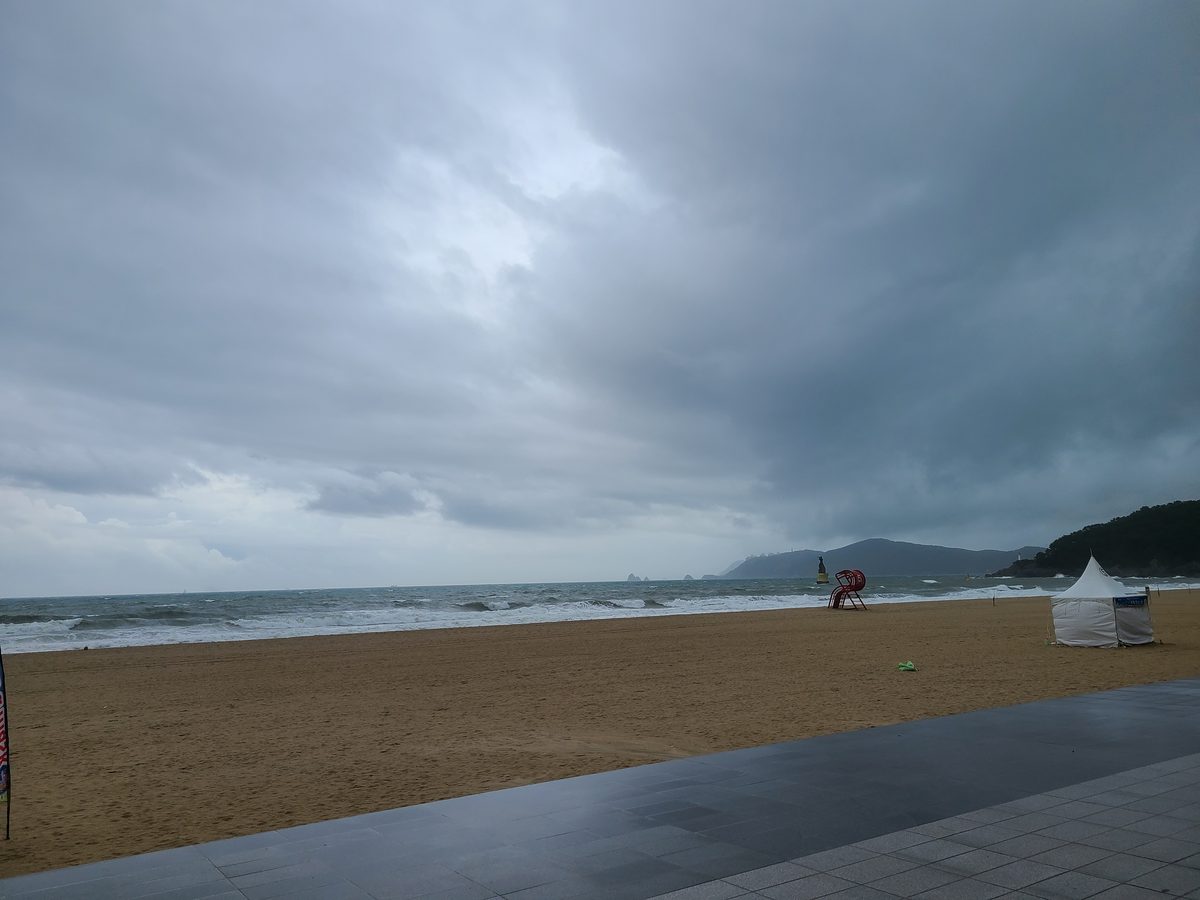
During the bathing season — roughly late June to mid-September — parasols stand in rows and the whole strand becomes one great summer resort. Yet Haeundae arguably shows its best face off-season, when the emptied sand lets you walk the full length in one go, from Dongbaek Island in the west to Mipo in the east. After sunset, when the lights come on in the towers behind, the sound of the surf and the city's night view overlap into a scene that belongs to this beach alone.
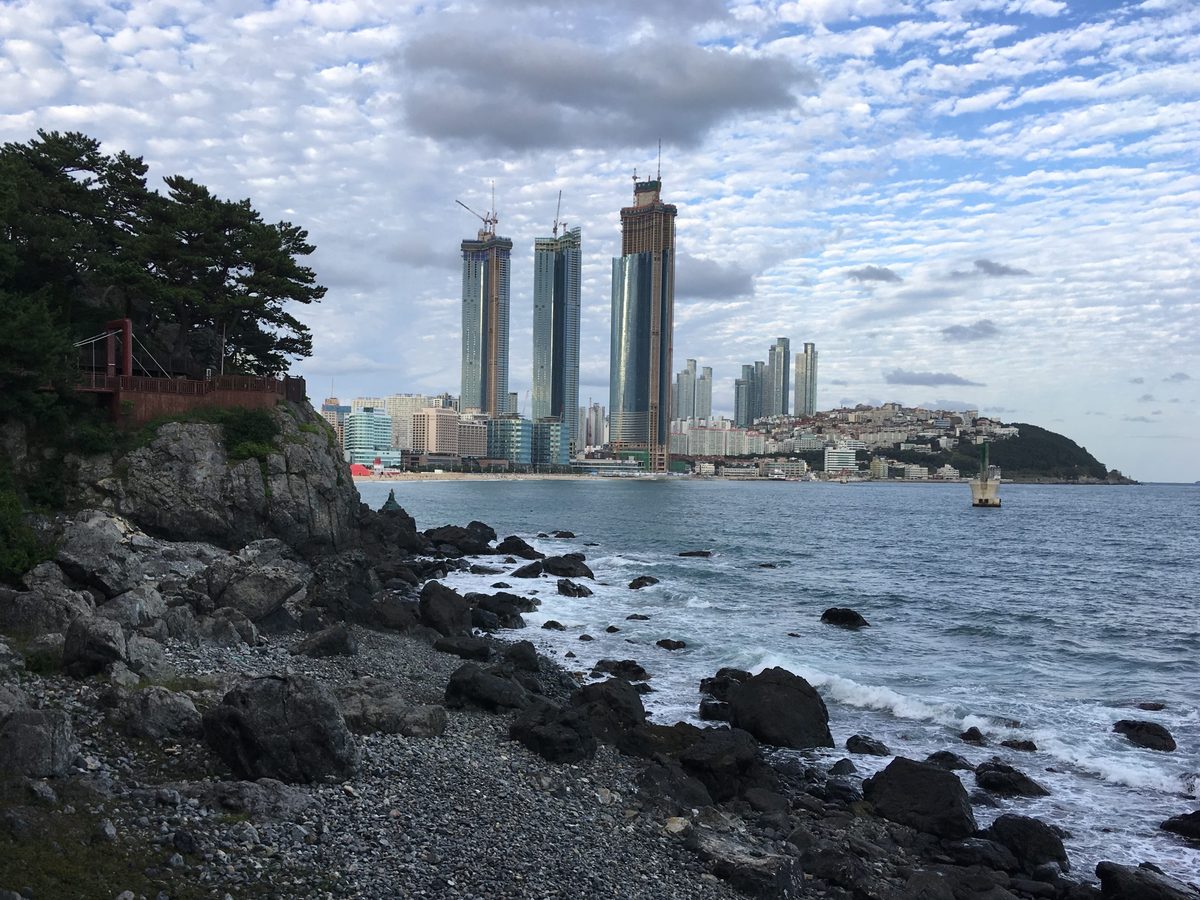
- ›Dongbaek Island and the 海雲臺 InscriptionThe wooded island at the western end of the sand, where a shoreline loop of about 950 m passes the statue of Choe Chi-won, the Haeunjeong pavilion, and the rock inscription that gave the place its name.
More
It was once a true island, but sand built up over the centuries until it joined the mainland; today it is a wooded walking ground of camellias and pines, designated a Busan Monument. The loop is mostly flat boardwalk and easy going, and where it opens to the sea you get the Gwangan Bridge and the towers of Marine City in one sweep. Partway along stands the mermaid statue of Princess Hwangok, from a local legend. The inscription itself is carved low on a rock and is easy to walk straight past — watch for the signs near the statue of Choe Chi-won.
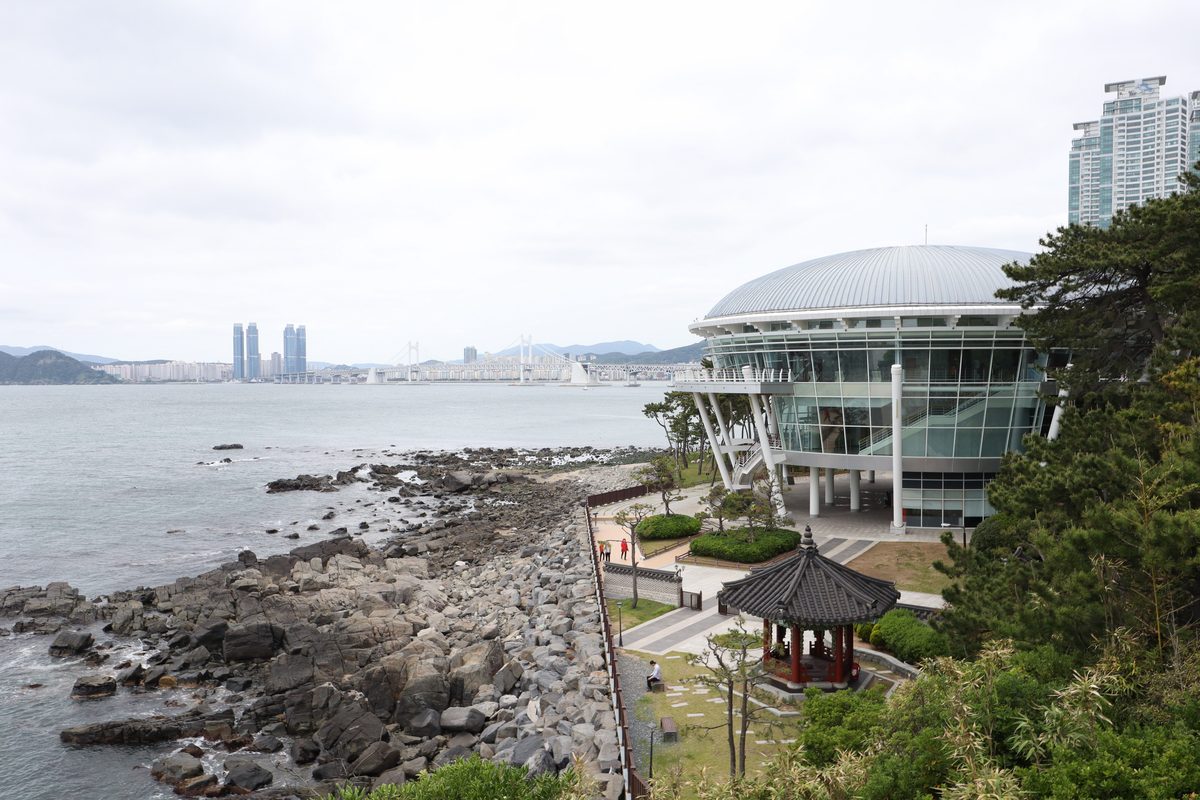
- ›Nurimaru APEC HouseThe round hall on the rocky headland at the tip of Dongbaek Island, built as the venue of the 2005 APEC summit in Busan. Admission is free.
More
Its roof, a modern reading of a traditional Korean pavilion, opens toward the water, so the windows of the summit chamber still frame the sea toward the Gwangan Bridge and the Oryukdo islets. The conference hall and exhibition rooms are open to visitors, with the 2005 seating arrangement and photographs from the summit on display. It sits directly on the island loop, so it folds into a walk without any detour. Opening hours and closing days can change, though, so it is worth checking the posted or official information before you go.
- ›Blue Line Park Beach TrainA tourist train on the revived tracks of the closed Donghae Nambu rail line, opened on 7 October 2020. Seven stops run from Mipo through Cheongsapo to Songjeong — about 25 minutes one way.
More
The seats face the windows on the sea side, so cliffs and surf slide past in front of you for the whole ride. The line starts at Mipo, at the eastern end of Haeundae's sand, so it follows on naturally from a walk along the beach, and the far end at Songjeong drops you at another beach to carry the day on. If you would rather walk, a coastal path runs alongside the tracks as far as Cheongsapo. Fares and timetables change often — check the official information before you go.
🚶 Self-Guided Walk
- 1Haeundae Station, Exit 5Leave Exit 5 at Haeundae Station on Line 2 and head straight south along the shopping street to the sand. Haeundae begins where the sea first appears between the buildings.💡 About an 8-minute walk. On summer weekends this street is the most crowded stretch of the whole trip.
- 2The Western End of the SandWalk west with the sea on your right. Only by crossing it do you feel how wide 70 to 90 m of sand really is.
- 3The Dongbaek Island LoopA loop of about 950 m that continues straight on from the western end of the beach. Under the camellia trees you pass, in turn, the statue of Choe Chi-won, the Haeunjeong pavilion, and the 海雲臺 rock inscription.💡 The inscription is carved low on the rock and the 雲 character is badly weathered — follow the signs and take your time finding it.
- 4Nurimaru APEC HouseWhere the loop reaches the headland at the island's tip stands the hall that hosted the 2005 APEC summit. Go in free of charge, see the chamber and the exhibits, and look out over the sea toward the Gwangan Bridge.
- 5Back Across the Sand to MipoReturn to the beach and walk it the other way, all the way east. Where the sand ends is Mipo, a small harbor lined with restaurants.💡 The sand runs about 1.5 km, so end to end is roughly half an hour at an easy pace.
- 6Blue Line Park Beach TrainBoard the beach train at Mipo and it follows the old Donghae Nambu line past Cheongsapo to Songjeong — seven stops and about 25 minutes of sea views, a good way to close the day.💡 If you prefer to walk, a coastal path runs beside the tracks as far as Cheongsapo.
🧭 Visitor Info
💡 Good to Know
- The bathing season generally runs from late June to mid-September, with the exact dates shifting year to year (in 2026 it opens on 26 June). Outside the season the beach and the island path are still open to walk, so spring and autumn are actually the better choice if you want Haeundae without the crowds.
- The 海雲臺 inscription is the origin of the beach's name, yet it is carved low on the rock and the 雲 character is so weathered that visitors often walk right past it. Watch the signs along the Dongbaek Island loop and take a moment to look.
- The Dongbaek Island loop is about 950 m and mostly flat, so a circuit including Nurimaru takes little more than half an hour. Combined with a walk along the sand it makes an easy half-day.
- Fares and timetables for the Blue Line Park beach train change frequently, and waits can be long in peak season. If you plan to ride, check the official information for that day's service before you set out.
🗺 Pair Your Visit
Choe Chi-won, the man behind the name Haeundae, is the classic example of a six-head-rank intellectual in late Silla and a regular on the Korean History Proficiency Test. He went to study in Tang China in 868, passed the examination for foreign candidates in 874, and made his name with the 'Proclamation Against Huang Chao'; in 894 he submitted his 'Ten-odd Urgent Points' to Queen Jinseong, and when they went unheeded he left office and withdrew to Haeinsa Temple. A frequent trap: the 'Twenty-eight Urgent Points' were submitted by Choe Seung-no under King Seongjong of Goryeo — a different memorial by a different man.