1 Unified Silla's Consolidation of Government — King Sinmun's Reforms
Right after unification, King Sinmun put down the revolt of his father-in-law Kim Heumdol, purged many jingol nobles, and established strong royal authority. The system organized at this time became the backbone of Silla's 200-year golden age that followed.
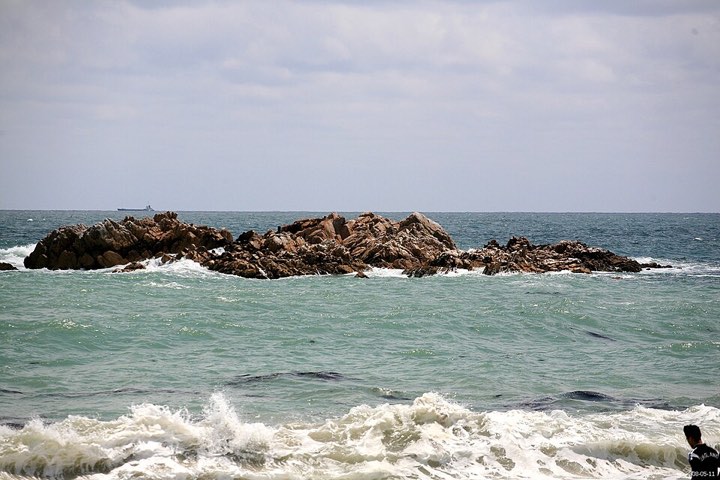
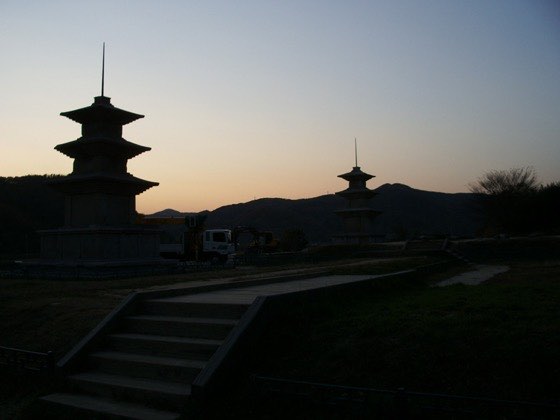
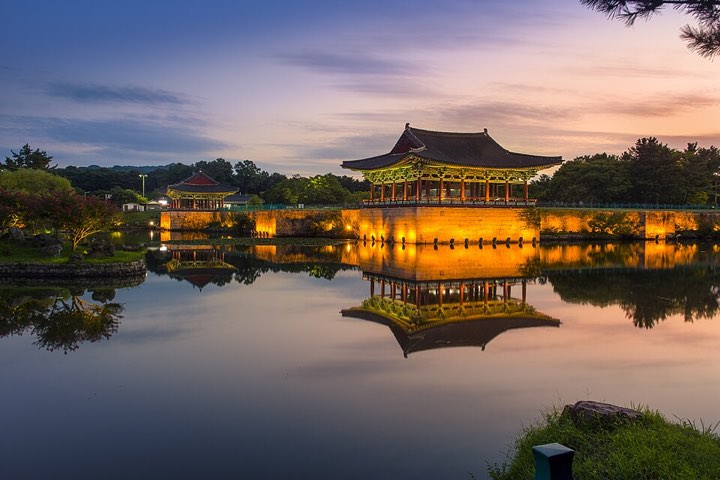
Photos — Tomb of King Munmu: Junho Jung, CC BY-SA 3.0 · Gameunsa stone pagoda: InSapphoWeTrust, CC BY-SA 2.0
- Local administration — nine provinces and five secondary capitals (9ju 5sogyeong): three provinces each on the old lands of Goguryeo, Baekje, and Silla (intended to fuse the peoples), while the five secondary capitals offset the weakness of the capital Gyeongju being tucked away in the southeast and kept regional powers in check. The sangsuri system (keeping local elites in the capital — the origin of Goryeo's giin system).
- Military system — the nine seodang (central army): it included not only Silla people but also Goguryeo, Baekje, and Malgal people (distinguished by collar color) — a policy of embracing conquered peoples. The ten jeong (provincial army, with two jeong only in the border province of Hanju).
- Devices to strengthen royal power — granting office land (gwallyojeon, 687) and abolishing nogeup stipend villages (689) (cutting off the nobles' control of land and labor), founding the Gukhak academy (682, Confucian education — buttressing kingship with the ideals of loyalty and filial piety), and strengthening the authority of the sijung of the Jipsabu ↔ weakening the Hwabaek council and the sangdaedeung.
- Later changes — under King Gyeongdeok, the revival of nogeup (757, a sign that noble power was growing again), and King Wonseong's doksosampumgwa (788, an attempt to select officials by examination on the Confucian classics — blocked by the wall of the bone-rank system, it had little effect).
Exam points
- The King Sinmun set: suppression of Kim Heumdol's revolt + nine provinces and five secondary capitals + nine seodang and ten jeong + office land and abolition of nogeup + the Gukhak academy.
- Abolition of nogeup (King Sinmun, royal power ↑) ↔ revival of nogeup (King Gyeongdeok, noble power ↑) — a contrast-of-direction question.
- The sangsuri system → carried on as Goryeo's giin system (a question on institutional continuity).
2 The Economy and Society of Unified Silla
With territory and population expanded by unification, Silla prospered through a precise tax-collection system and lively international trade. The census document (minjeong munseo) found in Japan attests to that precision.
- The census document (Silla village register) — found in the Shōsōin at Tōdai-ji in Japan. A record of four villages near Seowon-gyeong (Cheongju): population (by sex and in six age grades), the types and area of land, cattle and horses, and even the numbers of mulberry, nut-pine, and walnut trees, surveyed by the village headman every three years. Its purpose = a thorough grasp of labor and productive resources (the basis for levying taxes, tribute, and corvée).
- Aristocratic life — geumiptaek (gold-adorned mansions) and sajeol yutaek (seasonal villas), with slaves and private soldiers. Farmers, by contrast, were burdened by taxes, tribute, and corvée and fell into slavery in bad harvest years — the background to the uprisings of late Unified Silla.
- International trade — the port of Ulsan (an international trade port visited even by Arab merchants — the Western faces on the stone guardians at the Tomb of King Wonseong) and Danghangseong (trade with Tang). In Tang China there were Silla-bang (residential quarters), Silla-so (offices), and Silla-won (temples, such as Jang Bogo's Beophwa-won).
- Jang Bogo — set up Cheonghaejin on Wando Island (828, King Heungdeok) and, after clearing out pirates, dominated the Tang–Silla–Japan triangular trade — the "Sea King." He later intervened in a struggle for the throne, was assassinated (846), and Cheonghaejin was abolished — a glimpse of the turmoil in central politics.
Exam points
- Three keywords for the census document: every three years + compiled by the village headman + a grasp of labor and resources (for tax collection). A staple of source-based questions.
- Jang Bogo = Cheonghaejin (Wando) + Beophwa-won (Shandong). Silla-bang and Silla-won = the Silla community within Tang.
- Evidence of contact with Westerners at the port of Ulsan = the stone military guardians at the Tomb of King Wonseong (Gwaereung).
3 The Development of Buddhist Thought — Wonhyo and Uisang
Around the time of unification, Silla Buddhism came down from a religion of the court and nobility to a religion of the common people. At its center stood two giants, Wonhyo and Uisang — telling the two monks apart is the most frequently tested point in this unit.
| Category | Wonhyo (617–686) | Uisang (625–702) |
|---|---|---|
| Core thought | The One-Mind teaching · the Hwajaeng thought (reconciling sectarian disputes — the Simmun hwajaeng-non) | Hwaeom (Avatamsaka) thought ("one is the whole" — the Hwaeom ilseung beopgye-do) |
| Popularization | Amitabha faith — reciting only "Namu Amita-bul" leads to rebirth in paradise. He roamed everywhere singing the Muae-ga (Song of No Hindrance) | Amitabha plus Avalokitesvara faith (relief from suffering in this life) |
| Life and deeds | Gave up studying abroad ("everything depends on the mind" — the skull-water anecdote); father of Seol Chong | Studied in Tang (under Zhiyan), founded Buseoksa temple, and dissuaded King Munmu from a construction project |
| Writings | The Daeseung gisillon-so and the Geumgang sammaegyeong-non | The Hwaeom ilseung beopgye-do |
- Hyecho — his record of pilgrimage through India and Central Asia, the Wang ocheonchukguk-jeon (held by the National Library of France — found at Dunhuang).
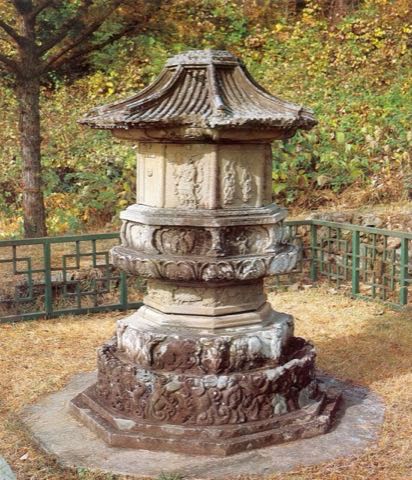
- The rise of Seon (Zen) Buddhism (late Silla) — "not relying on words, mind to mind" (bullip munja, seeing one's nature to attain enlightenment). Unlike the scripture-centered Gyo schools (of the nobility), it stressed meditation → with the patronage of provincial gentry (hojok), the Nine Mountain Seon schools were formed. This is the background for the vogue of monks' stupas (budo), such as the Cheolgam Seonsa Stupa at Ssangbongsa.
- Geomancy (pungsu jiri) (Doseon) — "Gyeongju is not the only auspicious site" → a reappraisal of provincial centers → an ideological weapon for the local gentry and a background to the split into the Later Three Kingdoms and the founding of Goryeo.
Exam points
- Wonhyo (Hwajaeng, Amitabha, Muae-ga, Daeseung gisillon-so) vs. Uisang (Hwaeom, Buseoksa, Avalokitesvara) — the most common comparison.
- Seon Buddhism = late Silla + local gentry + the Nine Mountain Seon schools + monks' stupas. Contrast with the Gyo schools (scriptures, nobility).
- The Wang ocheonchukguk-jeon = Hyecho = a record of pilgrimage to India.
4 The Buddhist Art of Unified Silla
Silla's Buddhist art reached its peak under King Gyeongdeok. Bulguksa temple and Seokguram Grotto (UNESCO World Heritage) embody an "ideal Buddha-land" on earth through an aesthetic of balance, proportion, and harmony.
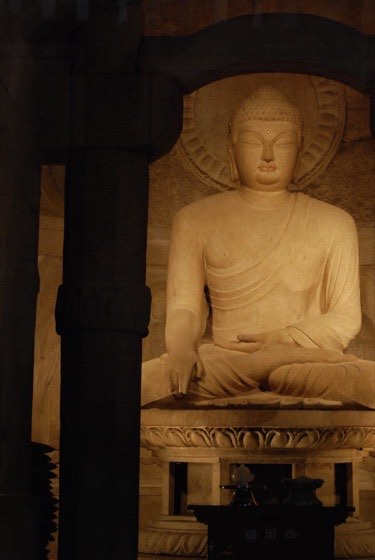
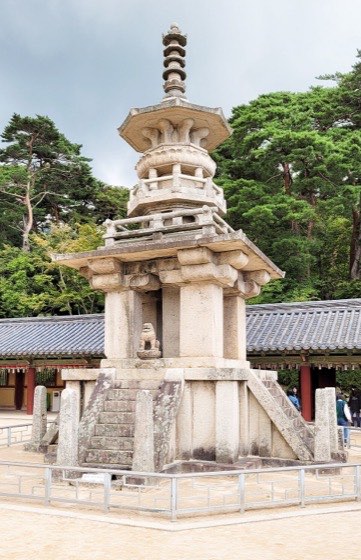
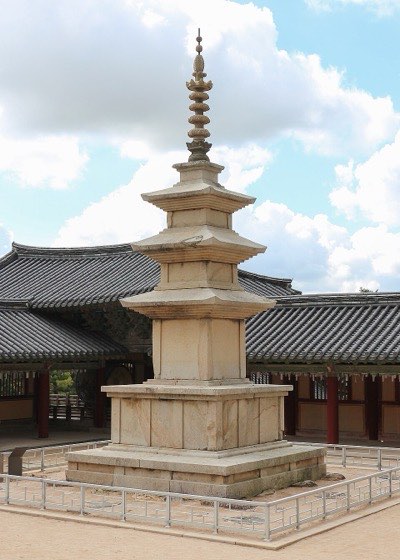
Photo — principal Buddha of Seokguram: myllissa, CC BY 2.0
- Seokguram — the principal Buddha sits inside an artificial domed grotto assembled from granite. A work of scientific architecture, calculated down to perfect bilateral symmetry, mathematical proportion, and even natural ventilation and humidity control.
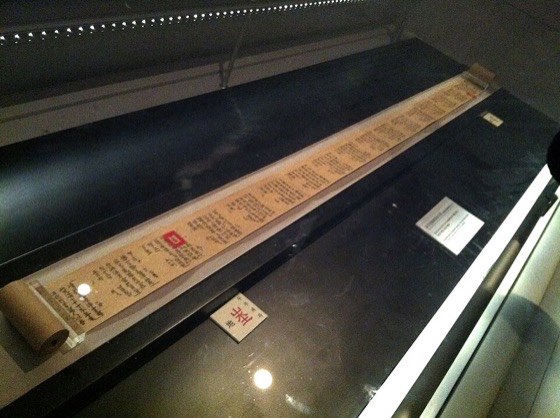
- Bulguksa — the Cheongun-gyo and Baegun-gyo bridges (from the mundane world to the Buddha-land) and the contrast between the three-story stone pagoda (Seokgatap) and Dabotap (simple and balanced vs. ornate and original). During the dismantling and repair of Seokgatap, the Great Dharani Sutra was found — the world's oldest surviving woodblock print.
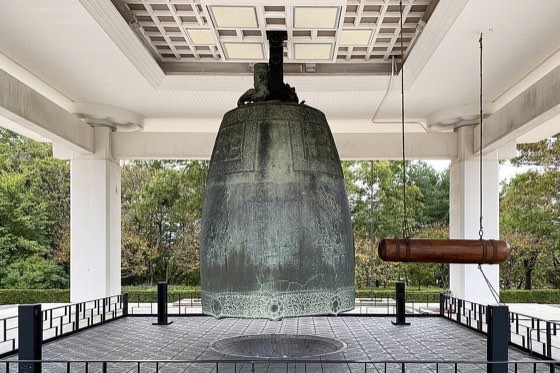
- Buddhist bells — the bronze bell of Sangwonsa (the oldest surviving) and the Divine Bell of King Seongdeok (the Emille Bell — with flying-apsara designs and a mysterious, lingering tone).
- Lineage of pagodas — the three-story stone pagoda at the Gameunsa site (King Sinmun, in memory of his father King Munmu — the grandeur of the years just after unification) → the three-story stone pagoda of Bulguksa (the perfected standard type) → the late-Silla vogue for monks' stupas and memorial steles (Seon Buddhism — enshrining monks' relics).
- The legend of Kim Daeseong — "Bulguksa for his parents in this life, Seokguram for his parents in a former life" (Samguk yusa).
Exam points
- The Great Dharani Sutra = the world's oldest woodblock print (Seokgatap) ↔ distinguish from the Jikji (Goryeo, movable metal type) — asked repeatedly.
- Image matching for the Gameunsa-site pagoda (King Sinmun, in memory of King Munmu) and the Divine Bell of King Seongdeok (the Emille Bell).
- The vogue for monks' stupas = paired with late-Silla Seon Buddhism.
5 The Founding and Growth of Balhae — the 'Flourishing Land in the East'
Thirty years after the fall of Goguryeo, the Goguryeo refugee Dae Joyeong led the Malgal people and founded Balhae at Dongmosan (698). This era, in which Balhae coexisted with Silla to the south, is called the North–South States period — a term first used by Yu Deukgong in his Balhae-go, reflecting the view of Balhae's history as part of Korean history.
- King Mu (Dae Muye) — era name 'Inan.' Against an encirclement by Tang, Silla, and the Heuksu Malgal, he launched Jang Munhyu's attack on Shandong (Dengzhou) (732) — a hardline diplomacy linking up with the Göktürks and Japan.
- King Mun (Dae Heummu) — era name 'Daeheung.' He turned to friendly relations with Tang (adopting the Three Chancelleries and Six Ministries, sending students), moved the capital to Sanggyeong Yongcheonbu, and set up a permanent route to Silla (the Silla-do). He styled himself 'King of Goryeo' and a Buddhist holy king (cakravartin).
- King Seon (Dae Insu) — the greatest territory (from the Maritime Province to Liaodong), completing the system of five capitals, fifteen prefectures, and sixty-two districts. Tang called it the Haedong seongguk ('flourishing land east of the sea'). It produced many who passed Tang's bingonggwa examination for foreigners.
- Consciousness of succeeding Goguryeo — in state letters to Japan its ruler called himself "King of Goryeo (Goguryeo)," claiming to "carry on the customs of Buyeo and recover the old lands of Goguryeo," and most of the ruling class were of Goguryeo descent (the Dae and Go clans). The single most important exam point.
- Fall (926) — Sanggyeong fell to the invasion of Yelü Abaoji of the Khitan (Liao). Refugees mounted revival movements (such as Jeongan-guk), and many sought asylum in Goryeo (Wang Geon honored the Balhae crown prince Dae Gwanghyeon with the royal Wang surname — Goryeo's sense of national reunification).
Exam points
- King Mu (Inan, attack on Shandong, hardline) vs. King Mun (Daeheung, capital moved to Sanggyeong, pro-Tang) vs. King Seon (the 'flourishing land in the east') — matching by king.
- Grounds for succeeding Goguryeo: the state letters to Japan + the makeup of the ruling class + the cultural elements (in the next section).
- Independent era names (Inan, Daeheung) = a sense of being Tang's equal. Balhae refugees' asylum in Goryeo = a connection in national history.
6 The Culture of Balhae — "Built on Goguryeo, Adopting Tang"
The formula for Balhae's culture is a threefold structure: "succession from Goguryeo + adoption of Tang culture + indigenous Malgal." Exams ask you to identify which strand each artifact belongs to.
| Strand | Evidence: artifacts & sites |
|---|---|
| Succession from Goguryeo | Ondol (heated-floor) remains, corridor-style stone chamber tombs with corbeled ceilings (the Tomb of Princess Jeonghye), lotus-patterned roof tiles, the twin-Buddha statue, and stone lion statues |
| Adoption of Tang culture | The Jujak Avenue of Sanggyeong (modeled on Tang's Chang'an), brick tombs (the Tomb of Princess Jeonghyo), and the Three Chancelleries and Six Ministries (with its own names and operation) |
| Independent & indigenous | Government centered on the Jeongdangseong, the six ministries named for Confucian virtues (loyalty, benevolence, righteousness, wisdom, propriety, and trust), and Malgal-style pottery |
- Tomb of Princess Jeonghye vs. Tomb of Princess Jeonghyo — both daughters of King Mun. Jeonghye (corridor-style stone chamber with a corbeled ceiling = Goguryeo style) / Jeonghyo (brick tomb = Tang style, with interior murals). The tombs of two daughters of the same king perfectly display the dual nature of Balhae culture.
- The five trade routes — the Silla-do, Ilbon-do, Georan-do, Yeongju-do, and Jogong-do. Major exports: the horses of Solbin-bu (fine steeds), furs, and ginseng.
- Buddhist culture — more than ten temple sites at Sanggyeong, a stone lantern (6 m tall — the grand spirit of Goguryeo), and the Yeonggwang Pagoda (a brick pagoda).
- Confucian learning — the Jujagam (educational institution); its students vied with Silla's for the top place in Tang's bingonggwa (the 'ranking dispute' incident — a sense of rivalry between the northern and southern states).
Exam points
- Tomb of Princess Jeonghye (Goguryeo style) vs. Tomb of Princess Jeonghyo (Tang style) — the key contrast in Balhae-culture questions.
- The Jujak Avenue of Sanggyeong = adoption of Tang / ondol and the twin-Buddha statue = succession from Goguryeo. A strand-classification question.
- The horses of Solbin-bu = a Balhae specialty. The Jujagam = Balhae's educational institution (contrast with Silla's Gukhak).
7 The Turmoil of Late Silla and the Rise of the Later Three Kingdoms
From the late 8th century, the jingol nobles' struggles for the throne (20 kings in about 150 years) broke down the central government, and as the local gentry (hojok) grew in the provinces and new ideas spread, the Later Three Kingdoms period began.
- Collapse of the center — after the assassination of King Hyegong (780), struggles for the throne: Kim Heonchang's revolt (822, Ungju — in protest that his father had lost the contest for the throne) and Jang Bogo's revolt (846). Under Queen Jinseong, pressure to collect taxes → the revolt of Wonjong and Aeno (889, Sabeolju — the first large-scale peasant uprising) → roving bandits such as the Jeokgojeok ran rampant.
- Growth of the local gentry — calling themselves 'castle lords' or 'generals,' they became semi-independent powers with a fortified base, private soldiers, and economic strength. Their origins: village headmen, nobles who had retired to the countryside, maritime powers (Wang Geon's family), and garrison powers (Gyeon Hwon).
- The defection of the 6th head-rank — Choe Chiwon (passed Tang's bingonggwa; the 'Proclamation Denouncing Huang Chao' and the Gyewon pilgyeong): he offered Queen Jinseong a reform proposal in some ten articles (simu sipyeojo) → blocked by the wall of the jingol, he gave up and went into seclusion. Choe Seungu (who went to Later Baekje) and Choe Eonwi (who went to Goryeo) — the paths of the "Three Choes" symbolize Silla's collapse.
- New ideas — Seon Buddhism (the spiritual base of the local gentry) + geomancy (Doseon — breaking free of Gyeongju-centered thinking) + Maitreya faith (Gung Ye called himself the Maitreya Buddha).
- Rise of the Later Three Kingdoms — Gyeon Hwon's Later Baekje (900, Wansanju): of military origin, he conducted diplomacy with Wuyue in China and was hostile to Silla (raiding Gyeongju in 927 and killing King Gyeongae). Gung Ye's Later Goguryeo (901, Songak → Cheorwon): a monk of Silla royal descent; he renamed the state Majin, then Taebong, and set up the Gwangpyeongseong — but calling himself the Maitreya Buddha and ruling tyrannically, he lost the people's hearts → his vassals enthroned Wang Geon (918). The unification process is in Unit Ⅲ.
Exam points
- The revolt of Wonjong and Aeno (889, Queen Jinseong) = a symbol of Silla's collapse — asked with a source ("the provinces and districts of the realm failed to send tribute…").
- The late-Silla set of four: local gentry + the 6th head-rank + Seon Buddhism + geomancy — appearing together in one question.
- Choe Chiwon = the 6th head-rank + the bingonggwa + the ten-article reform proposal + the Gyewon pilgyeong.
- Distinguish Gyeon Hwon (Wansanju, killing of King Gyeongae) from Gung Ye (Cheorwon, Maitreya Buddha, Gwangpyeongseong).