1 Life in Prehistory — the Paleolithic and Neolithic
The history of the Korean Peninsula begins in the Paleolithic, about 700,000 years ago. Because prehistory left no written records, life is reconstructed from artifacts and sites. On exams, questions that link "tool → period → way of life" appear most often.
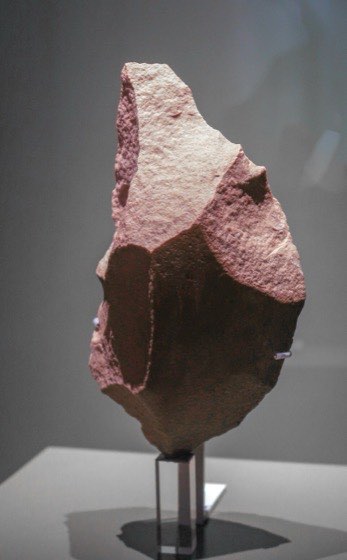
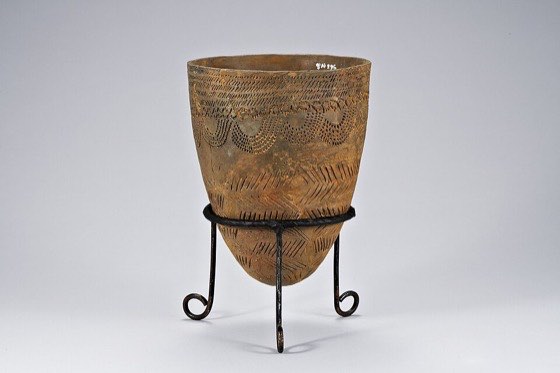
Photos — hand axe: Ismoon, CC BY-SA 4.0 · comb-pattern pottery: National Museum of Korea (KOGL Type 1)
| Category | Paleolithic (from c. 700,000 years ago) | Neolithic (from c. BC 8000) |
|---|---|---|
| Tools | Chipped stone tools — hand axes, choppers, scrapers, and tanged points in the later period | Ground stone tools — grinding stones and slabs, comb-pattern pottery, spindle whorls, and bone needles |
| Economy | Hunting, gathering, and fishing (mobile life) | Beginning of farming (millet) and herding — the Neolithic Revolution |
| Dwellings | Caves and riverside huts | Pit dwellings by rivers and coasts (round floor, central hearth) |
| Society | Band society · egalitarian | Tribal society · egalitarian (early religion appears) |
| Key sites | Jeongok-ri (Yeoncheon), Seokjang-ri (Gongju), Suyanggae (Danyang) | Amsa-dong (Seoul), Dongsam-dong (Busan), Osan-ri (Yangyang) |
- Jeongok-ri, Yeoncheon (1978) — the first Acheulean-type hand axe found in East Asia. This overturned the Movius line theory, which held that "East Asia had only a chopper culture," and became a landmark in world archaeology.
- The pointed base of comb-pattern pottery was meant to be stuck upright in riverbank sand — link this to why the sites cluster along rivers and coasts.
- Neolithic beliefs: animism (spirits in natural objects), totemism (worship of animals), shamanism (through shamans), plus ancestor worship.
Exam points
- Hand axes and huts = Paleolithic / comb-pattern pottery, pit dwellings, and spindle whorls = Neolithic. Matching artifact photos is a common question type.
- Whenever you see "the beginning of farming and settled life," it means the Neolithic Revolution.
- Both the Paleolithic and Neolithic were classless, egalitarian societies — classes emerged only in the Bronze Age.
2 The Bronze Age and Gojoseon
Around BC 2000–1500, the spread of bronze fundamentally changed society. As rice farming took hold and surplus was produced, private property and social classes emerged, and as stronger tribes absorbed weaker ones, chieftains (gunjang) arose. On this basis Gojoseon, the first state in Korean history, was founded.
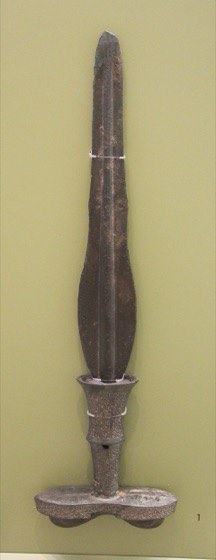
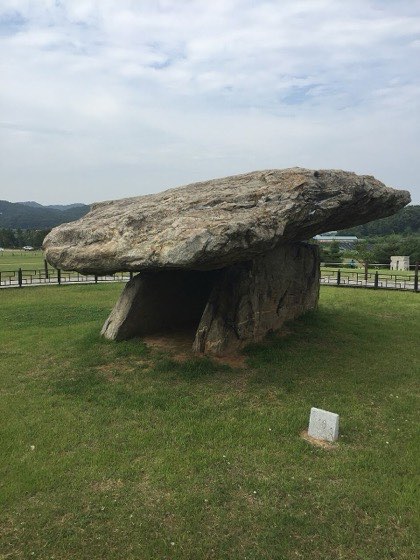
Photos — lute-shaped bronze dagger: Gary Lee Todd, CC BY-SA 4.0 · Ganghwa dolmen: ChongDae, CC BY-SA 3.0
- Bronze Age artifacts — the lute-shaped bronze dagger and coarse-patterned mirror (bronze = the elite's weapons and ritual objects), plus plain (mumun) pottery and the half-moon stone knife (farming tools were still stone!). The fact that there were no bronze farming tools appears as a trick question.
- Dolmens (goindol) — about 40% of the world's dolmens are concentrated on the Korean Peninsula. The Gochang, Hwasun, and Ganghwa sites are UNESCO World Heritage (2000). Mobilizing labor to move stones weighing tens of tons is evidence of a class society and the rise of chieftains.
- Dangun Wanggeom = Dangun (high priest) + Wanggeom (political ruler) → a society with the unity of religious and political rule. In the Dangun myth, "benefit all humankind" (hongik ingan) is the founding ideal, the bear and tiger reflect totemism, and "he governed the wind, rain, and clouds" reflects an agrarian society.
- The Eight Prohibitions (8jo-beop) — three articles survive: a murderer is executed (life valued), injury is compensated with grain (labor valued), and a thief is made a slave (private property and a class society).
- Wiman Joseon — Wiman ousted King Jun and took power (BC 194). It fully adopted ironware and grew through intermediary trade between Han China and the Jin state → to check this, Emperor Wu of Han invaded, taking the capital Wanggeom-seong (BC 108) and setting up the Four Commanderies of Han.
Exam points
- A distribution map of lute-shaped bronze daggers and dolmens = a question asking for Gojoseon's cultural range.
- Link each article of the Eight Prohibitions to a social feature (life, labor, private property).
- The keywords for Wiman Joseon are "ironware + intermediary trade." Distinguish it from Dangun Joseon.
3 The Iron Age — the Growth of Early States
Around the 4th century BC, ironware spread: iron farming tools raised productivity and iron weapons fueled wars of conquest. Around the fall of Gojoseon, several states grew across Manchuria and the peninsula, and these are the roots of the Three Kingdoms. Questions that distinguish each state's customs are the most frequent in this unit.
| State | Location | Politics | Sky-worship festival | Key customs |
|---|---|---|---|---|
| Buyeo | Songhua River, Manchuria | Five-tribe confederation (sachul-do — Maga, Uga, Jeoga, Guga) | Yeonggo (12th month) | Human sacrifice burial, twelvefold restitution law, levirate marriage |
| Goguryeo | Jolbon → Gungnae-seong | Five-tribe confederation, the Jega council | Dongmaeng (10th month) | Seook-je (matrilocal son-in-law marriage), marriage by abduction |
| Okjeo | Hamgyeong coast | Eupgun and samno chiefs (no king) | — | Minmyeoneuri-je (child bride custom), family communal tombs |
| Dongye | Gangwon coast | Eupgun and samno chiefs (no king) | Mucheon (10th month) | Chaekhwa (boundary trespass fines), exogamy, and specialties: the dangung bow, gwahama pony, and baneopi (sealskin) |
| Samhan | Southern Korean Peninsula | Sinji and eupcha chiefs, the priest cheon-gun and sacred sodo zones (separation of religion and politics) | Seasonal rites in the 5th and 10th months | Iron exports from Byeonhan, dure (communal labor) |
- Iron Age artifacts: the slender bronze dagger (a Korean-style dagger) and its casting molds — the culmination of an independent bronze culture. Chinese coins (myeongdojeon, ballyangjeon, osujeon) and a brush from Daho-ri in Changwon are evidence of exchange with China and the use of Chinese characters.
- In Samhan, the sodo was a sacred zone beyond the chieftain's reach — evidence of a society that separated religion and politics (contrast with the unity of the two in Gojoseon).
- Byeonhan's iron was exported to Nangnang and Wa and used like currency — the "iron tradition" later carried on by Gaya.
Exam points
- Match the sky-worship festivals: Yeonggo (Buyeo, 12th month) / Dongmaeng (Goguryeo) / Mucheon (Dongye) / seasonal rites (Samhan). Why only Buyeo held its rite in the 12th month (a hunting tradition) is sometimes asked.
- Distinguish the marriage customs: seook-je = Goguryeo, minmyeoneuri-je = Okjeo, levirate marriage = Buyeo and Goguryeo.
- "Eupgun and samno" = the kingless Okjeo and Dongye / "cheon-gun and sodo" = Samhan.
4 The Rise of the Three Kingdoms and Gaya — Foundation Myths and Centralization
Goguryeo, Baekje, Silla, and Gaya each have a foundation myth. Founders born from eggs (Jumong, Bak Hyeokgeose, Kim Suro) claimed descent from heaven, and the story of Onjo coming south from Goguryeo shows that Baekje's ruling class were migrants of Goguryeo origin. In other words, history is hidden within the myths.
The conditions for a confederated kingdom to grow into a centralized state are a frequent exam theme — ① father-to-son royal succession ② promulgation of a legal code (yullyeong) ③ adoption of Buddhism ④ territorial expansion. Each kingdom's golden age came in the order it met these four.
| State | Foundation myth | Consolidating king(s) | Key measures |
|---|---|---|---|
| Goguryeo | Jumong (King Dongmyeong) — moved south from Buyeo, Jolbon | King Taejo → King Gogukcheon → King Sosurim | Conquest of Okjeo and hereditary rule by the Go clan of Gyeru-bu (King Taejo); father-to-son succession and the jindaebeop relief system (King Gogukcheon); the Taehak academy, a legal code, and Buddhism (King Sosurim, 372) |
| Baekje | Onjo — son of Jumong, Wiryeseong (Han River) | King Goi | An office-rank system (six jwapyeong ministers and 16 grades) and official robes, laying the groundwork for a legal code |
| Silla | Bak Hyeokgeose — the egg at Najeong, the state of Saro | King Naemul | Established hereditary kingship in the Kim clan, adopted the title 'Maripgan,' and repelled the Wa (with support from Gwanggaeto the Great of Goguryeo) |
| Gaya | Kim Suro — the Song of Guji, Gimhae | (remained at the confederation stage) | An early confederation centered on Geumgwan Gaya — prospering through iron and intermediary trade |
- King Gogukcheon's jindaebeop (proposed by Eulpaso) — a relief system that lent grain in spring to be repaid in autumn. It began a tradition continued by Goryeo's uichang and Joseon's hwan-gok.
- Why Silla developed late — its position in the southeastern corner of the peninsula (poor access to Chinese culture) plus a tradition of a six-clan aristocratic coalition. Accordingly its royal title changed in stages: Geoseogan → Chachaung → Isageum → Maripgan → King (the changing titles trace the growth of royal power).
- Why Gaya failed to centralize — its geography, caught between Baekje and Silla, plus the independence of each small state. The phrase "remained at the confederated-kingdom stage" is a signature pointing to Gaya. The Gaya confederacy comprised six states: Geumgwan Gaya (Gimhae), Daegaya (Goryeong), Ara Gaya (Haman), Goryeong Gaya (Hamchang), Seongsan Gaya (Seongju), and So Gaya (Goseong).
Exam points
- Match the three elements of centralization (succession, legal code, Buddhism) to each consolidating king: King Sosurim (Goguryeo) / King Goi (Baekje) / King Naemul (Silla).
- Order of Silla's royal titles: Geoseogan → Chachaung → Isageum → Maripgan (King Naemul) → King (King Jijeung).
- Jindaebeop = King Gogukcheon = poverty relief. Often asked together with Eulpaso.
5 The Struggle Among the Three Kingdoms — the 4th–6th Centuries, Seizing the Han River
The backbone of the Three Kingdoms' rivalry is "the order of the golden ages by century": 4th century Baekje → 5th century Goguryeo → 6th century Silla. The common sign of a golden age is control of the Han River basin. On map questions, first check whose land the Han River is.
| Century | Leading power | Key events | Evidence: artifacts & steles |
|---|---|---|---|
| 4th century | King Geunchogo of Baekje | Annexed Mahan, attacked Pyongyang (King Gogugwon of Goguryeo killed in battle, 371), and built a maritime trade network (theorized advances into Liaoxi, Shandong, and Kyushu) | The Seven-Branched Sword (bestowed on the king of Wa) and the history Seogi compiled by Gohung |
| 5th century | Gwanggaeto the Great and King Jangsu of Goguryeo | Seized Manchuria and Liaodong and repelled the Wa who had invaded Silla (400) → decline of Geumgwan Gaya. King Jangsu: moved the capital to Pyongyang (427) and pushed south — took Hanseong, with King Gaero killed in battle (475) | The Gwanggaeto Stele (era name 'Yeongnak'), the Chungju Goguryeo Stele, and the inscribed Houmyeong vessel |
| 6th century | King Jinheung of Silla | Secured the upper Han River through the Silla–Baekje alliance → then broke the alliance and monopolized the Han River. The Battle of Gwansanseong (King Seong of Baekje killed, 554), annexation of Dae Gaya (562), and reorganization of the Hwarang | The Danyang Jeokseong Stele and four royal tour steles (Bukhansan, Changnyeong, Hwangchoryeong, Maunryeong) |
- The 5th-century chain reaction — Gwanggaeto the Great's rescue of Silla (400) saved Silla but led to interference in it (the Houmyeong vessel is evidence), while Geumgwan Gaya, tied to the Wa, was struck hard, shifting the center of the Gaya confederation to Dae Gaya. A case where a single event changed the fate of three states.
- The Silla–Baekje alliance (433–553) — formed by King Biyu of Baekje and King Nulji of Silla under pressure from King Jangsu's southward drive. After 120 years, King Jinheung broke it by seizing the lower Han River in a surprise attack → the enraged King Seong was killed at Gwansanseong. "The reason for forming the alliance and the result of breaking it" are asked as a set.
- Baekje's revival efforts — after moving the capital to Ungjin (475), King Muryeong controlled the provinces through the 22 damno districts (staffed with royal kin), and King Seong moved the capital to Sabi (538), renamed the state 'Nambuyeo,' and organized 22 central ministries. But it was undone at Gwansanseong.
- A Goguryeo-centered worldview — the Gwanggaeto Stele's era name 'Yeongnak' and the phrase "Baekjan (Baekje) and Silla were long our subjects." It reflects a sense of being China's equal.
- The Danyang Silla Jeokseong Stele — erected right after King Jinheung secured the upper Han River (Danyang Jeokseong), it records the dispatch of a dosa (local governor) to rule the area and rewards promised to local people who cooperated. Raised before the four Territorial Inspection Steles, it is Silla's earliest record of its advance into the Han River basin.
Exam points
- Memorize the order by century: 4th c. Geunchogo → 5th c. Gwanggaeto and Jangsu → 6th c. Jinheung. On maps, identify the century by who holds the Han River.
- Match the steles: the Gwanggaeto Stele and Chungju Stele (Goguryeo's southward drive) / the Danyang Jeokseong Stele and royal tour steles (King Jinheung's expansion).
- The Battle of Gwansanseong (554) = the result of breaking the Silla–Baekje alliance = the death of King Seong. Do not confuse it with the death of King Gogugwon (371, by King Geunchogo).
6 Goguryeo's Wars with Sui and Tang, and the Unification of the Three Kingdoms
When Sui unified China in the late 6th century, East Asia realigned into a north–south bloc (Göktürks–Goguryeo–Baekje–Wa) and an east–west bloc (Silla–Sui/Tang), a "cross-shaped diplomacy." While Goguryeo held off the Sui and Tang invasions, Silla joined hands with Tang and opened the road to unification.
- The Battle of Salsu (612) — Emperor Yang of Sui led an army of 1.13 million; Eulji Mundeok lured them with a feigned retreat and destroyed a 300,000-man detachment at the Salsu (Cheongcheon River). His five-character poem to the enemy general Yu Zhongwen ("be content and turn back") is famous. The overreaching campaign became a cause of Sui's fall (618).
- The Battle of Ansi-seong (645) — Emperor Taizong of Tang invaded, using Yeon Gaesomun's coup as a pretext. The soldiers and people of Ansi-seong repelled him after an 88-day defense. Goguryeo had prepared for a Tang invasion with the Cheolli Jangseong (Thousand-Li Wall) it had been building (631–647).
- The Silla–Tang alliance (648) — after King Uija of Baekje's attacks cost Silla even Daeya-seong, Kim Chunchu of Silla first went to Goguryeo (Yeon Gaesomun), was refused, and then allied with Tang. "Why did Tang agree?" = it needed a pincer attack on Goguryeo.
- The fall of Baekje (660) and the revival movement — at Hwangsanbeol, Gyebaek's 5,000-man death squad lost to Kim Yusin's 50,000, and Sabi fell. Revival forces: Boksin, Docim, and Buyeo Pung (at Juryu-seong) and Heukchi Sangji (at Imjon-seong). A large relief army from Wa was destroyed by the Silla–Tang forces at the Battle of Baekgang (663), and the movement collapsed.
- The fall of Goguryeo (668) and the revival movement — after Yeon Gaesomun's death, his sons' infighting led to the fall of Pyongyang. Revival movement: Geom Mojam enthroned Anseung as king (Silla made Anseung king of Bodeok-guk and used him to check Tang).
- The Silla–Tang War (670–676) — when Tang tried to swallow the whole peninsula through the Ungjin, Gyerim, and Andong protectorate offices, Silla confronted it head-on. It crushed the large Tang land army at the Battle of Maeso-seong (675) and the navy at the Battle of Gibeolpo (676) → expelling Tang and completing unification (King Munmu).
- Assessment — Limitations: reliance on a foreign power (Tang) and confinement to south of the Daedong River–Wonsan Bay line (losing most of Goguryeo's land). Significance: the first unification, a foundation for a shared national culture, and the independence shown by driving out Tang by force. A frequent essay topic.
Exam points
- Arrange the unification timeline: Salsu → Ansi-seong → Silla–Tang alliance → fall of Baekje → Baekgang → fall of Goguryeo → Maeso-seong and Gibeolpo.
- Match the revival movements: Boksin, Docim, and Heukchi Sangji (Baekje) / Geom Mojam and Anseung (Goguryeo). The Battle of Baekgang = the Wa supporting the Baekje revival forces.
- Maeso-seong (land army) and Gibeolpo (navy) = the Silla–Tang War — the final stage of unification.
7 Society and Economy of the Three Kingdoms — the Bone-Rank System and Noble Councils
All three kingdoms were rigid status societies under the king, with nobles, commoners, and the lowborn, and noble councils decided major affairs of state. In particular, Silla's bone-rank system (golpum) is the most frequently tested status system in all of Korean history.
| State | Noble council | Features |
|---|---|---|
| Goguryeo | The Jega council | A council of tribal chiefs (ga) — deciding major state affairs and punishment of serious criminals |
| Baekje | The Jeongsaam council | Gathered on a rock (Jeongsaam) to elect the chief minister |
| Silla | The Hwabaek council | Decision by unanimity — a symbol of coalition rule by the (jingol) nobility, chaired by the sangdaedeung |
- The bone-rank system — divided into seonggol and jingol (royalty) and the head-ranks 6 down to 1. One's rank set the ceiling on office: no matter how able, a 6th-head-rank man could rise only to the 6th office grade, achan (barred from minister or general) — so they were called 'deungnan' ("hard to attain") and turned to scholarship and religion (Wonhyo, Choe Chiwon). A closed status system that regulated not only office but even house size, clothing color, carriages, and dishware.
- The Hwarang — King Jinheung reorganized an old youth group into a state institution. Noble-born hwarang leaders plus nangdo followers of various ranks → it helped ease class tensions. Wonhwang's Five Secular Precepts (loyalty to the king, filial piety, faith among friends, never retreat in battle, and selective killing) were its code of conduct. It produced Kim Yusin and Sadaham.
- Economic life — under King Jijeung, ox-plowing began and the Dongsijeon (market supervision office) was set up. Nobles held nogeup and sigeup grants (control of land and labor), while farmers bore taxes, tribute, and corvée labor.
- Measures to stabilize the people's lives — relief that lent grain in years of famine, like Goguryeo's jindaebeop, was central to state stability (aimed at securing labor).
Exam points
- Match the three noble councils: Jega (Goguryeo) / Jeongsaam (Baekje) / Hwabaek (Silla, unanimity). A very common comparison question.
- Keywords for the bone-rank system: office ceilings + regulation of daily life + the frustration of the 6th head-rank (link to Wonhyo and Choe Chiwon).
- The Five Secular Precepts = Wonhwang = the Hwarang. "Never retreat in battle" is the signature precept.
8 The Culture of the Three Kingdoms and Gaya — and Its Transmission to Japan
The three kingdoms adopted Buddhism to strengthen royal power ("the king is the Buddha"), cultivated talent through Confucian learning, and each developed a distinctive culture that decisively influenced Japan's Asuka culture.
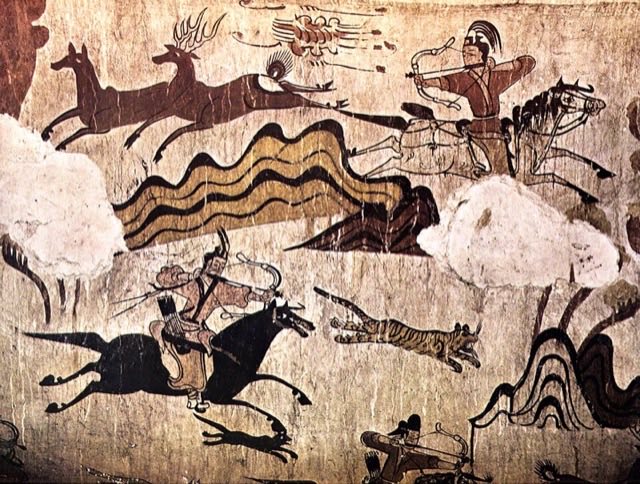
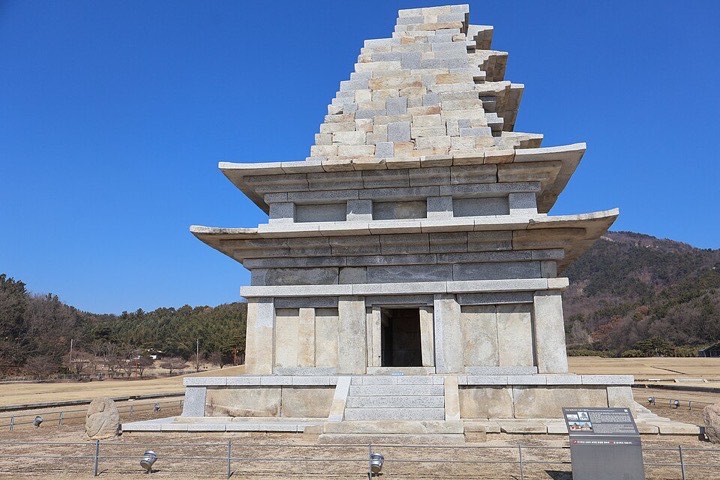
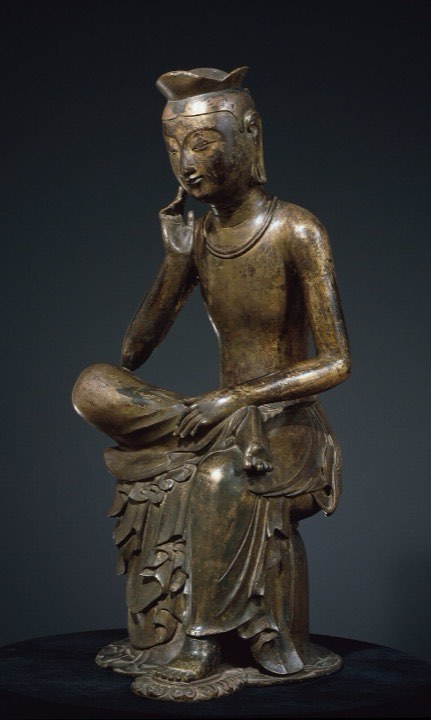
Photos — National Museum of Korea (KOGL Type 1) · Mireuksa stone pagoda: LandAndTree, CC BY-SA 4.0
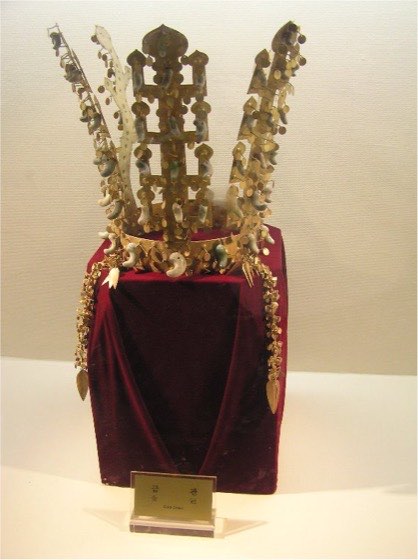
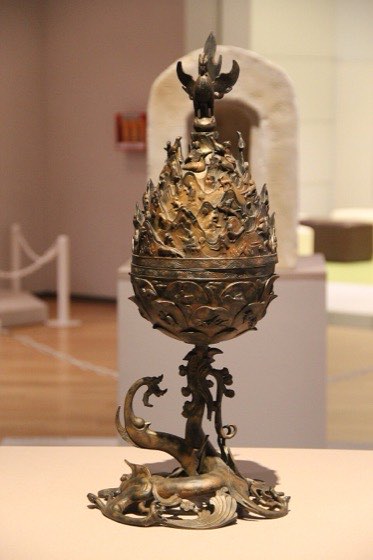
Photo — Cheonmachong gold crown: NW-Photos.com, CC BY 2.0
- Adoption of Buddhism — Goguryeo's King Sosurim (372, from Former Qin) → Baekje's King Chimnyu (384, from Eastern Jin) → Silla's King Beopheung (527, officially recognized after the martyrdom of Ichadon). Remember both the order and the routes.
- Traces of Daoism — Goguryeo's Four Guardians murals (Azure Dragon, White Tiger, Vermilion Bird, Black Tortoise), Baekje's landscape-patterned bricks, and the Baekje Gilt-bronze Incense Burner (an immortal realm plus lotus blossoms — a harmony of Daoism and Buddhism, the pinnacle of Baekje art).
- Tomb culture — Goguryeo: corridor-style stone chamber tombs with murals (the Muyongchong hunting scene, the Gangseo Great Tomb's Four Guardians). Baekje: brick tombs (the Tomb of King Muryeong — influenced by China's Southern Dynasties, found undisturbed in 1971). Silla: wooden-chamber tumuli with stone mounds (Cheonmachong — structurally without murals and hard to rob → rich in grave goods such as gold crowns).
- Pagodas and Buddha statues — Baekje: the stone pagoda at the Mireuksa site, Iksan (the oldest and largest surviving, in wooden-pagoda style) and the five-story stone pagoda at the Jeongnimsa site, Buyeo. Silla: the nine-story wooden pagoda of Hwangnyongsa (proposed by Jajang, lost in the Mongol invasions) and the stone-brick pagoda of Bunhwangsa. Statue: the Gilt-bronze Pensive Maitreya Bodhisattva — nearly identical to Japan's wooden Pensive Bodhisattva at Kōryū-ji (evidence of transmission).
- Confucian learning and histories — Goguryeo: the Taehak academy (capital) and gyeongdang schools (provinces, teaching letters and archery). Baekje: the Five Classics scholars (ogyeong baksa). Silla: the Imsin Vow Stone (young men's oath to study the Confucian classics). Histories: Goguryeo's Yugi → Sinjip, Baekje's Seogi (King Geunchogo), and Silla's Guksa (King Jinheung) — compiled by kings in their golden ages to display royal authority.
- Transmission to Japan — Baekje: Wang In (the Thousand Character Classic and the Analects) and Achikgi, and Norisachi-gye (Buddhist scriptures and statues). Goguryeo: Damjing (paper and ink; the Golden Hall murals of Hōryū-ji) and Hyeja (teacher of Prince Shōtoku). Silla: shipbuilding and dam-building. Gaya: Sue ware. → The formation of Asuka culture.
- Cheomseongdae (Queen Seondeok) — the oldest astronomical observatory in East Asia. In an agrarian society, observing the heavens = royal authority.
Exam points
- Match tomb type to state: has murals = corridor-style stone chamber (Goguryeo), brick = Tomb of King Muryeong (Baekje), gold crown and heavenly-horse painting = wooden-chamber tumulus with stone mound (Silla).
- Figures who transmitted culture to Japan: distinguish Wang In and Norisachi-gye (Baekje) from Damjing and Hyeja (Goguryeo).
- Kings who compiled histories: Seogi (King Geunchogo) and Guksa (King Jinheung) — paired with golden-age kings.
- The Pensive Bodhisattva (Korea) and the wooden Pensive Bodhisattva at Kōryū-ji (Japan) = the prime evidence of cultural transmission.