Jagalchi Market
Busan's kitchen, grown from a refugee waterfront
Jagalchi is a run of open-air stalls along Busan's South Port, paired with a modern main building shaped like a gull's outstretched wings, and it is widely considered Korea's largest seafood market. It stands on reclaimed land and grew up entirely in the twentieth century, so its history is short — but through liberation and the Korean War this waterfront carried the livelihood of a whole city. The nickname "Jagalchi ajumae," the market's women vendors, is a word left over from those years. The doors still open at five in the morning, and the old routine survives: buy your fish live on the first floor, carry it up to the second, and eat it raw within minutes.
📖 The Story
The most widely accepted explanation of the name is that this shore was once Nambin, a beach covered in pebbles — jagal in Korean. Other accounts are told as well: that "-chi" is a dialect ending meaning "place," or that the name comes from a fish called jagalchi. Either way, one thing is certain — the market stands on ground taken from the sea. In 1922 a Japanese fishing cooperative opened a consignment depot for seafood here, and when the Nambin foreshore was reclaimed in the 1930s to create the South Port, stalls began to line the new waterfront. The 1876 opening of the treaty ports, which comes up in every account of Busan, is not where this market begins: the treaty port grew on the site of the old Choryang Waegwan trading post, over toward Yongdusan and the North Port. Jagalchi is a twentieth-century market that rose much later, on filled land at the South Port.
As Koreans returning from abroad after liberation and refugees from the Korean War poured onto this waterfront, the strip of stalls then known as the Nampo-dong market became the place where a whole city made its living. At the center of it were the Jagalchi ajumae. War widows and displaced women set out a single basin of fish and fed their families from it, and the word for these women — who held those pitches across generations — became the market's own nickname. Before it meant the famously blunt sales patter of the Busan dialect, "Jagalchi ajumae" was a name for the women's labor that carried Korean society through the postwar years. The stalls that had gathered on their own were finally established as a market in 1970 and officially registered in 1972.
Today's Jagalchi keeps two faces side by side. One is the main building, completed in August 2006 as a modernization project and shaped like a gull spreading its wings: two basement levels and seven floors, with the live-fish hall on the first, the sashimi restaurants on the second, and an observation deck on the seventh, so the market never stops for rain. The other is the line of open-air stalls that still runs along the water outside, where women sit gutting fish exactly as they did long before the building went up. Every October the Jagalchi Festival, first held in 1992, fills the waterfront under its Busan-dialect slogan: "Oiso! Boiso! Saiso!" — Come! Look! Buy!
✦ Highlights
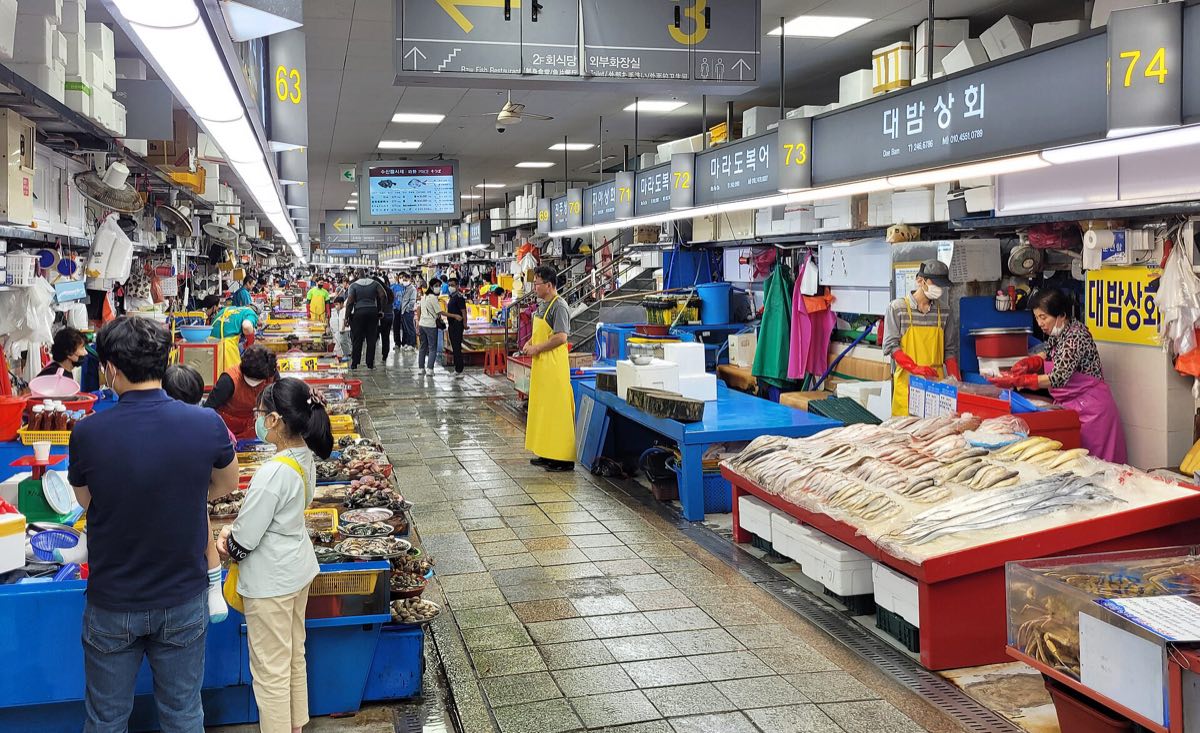
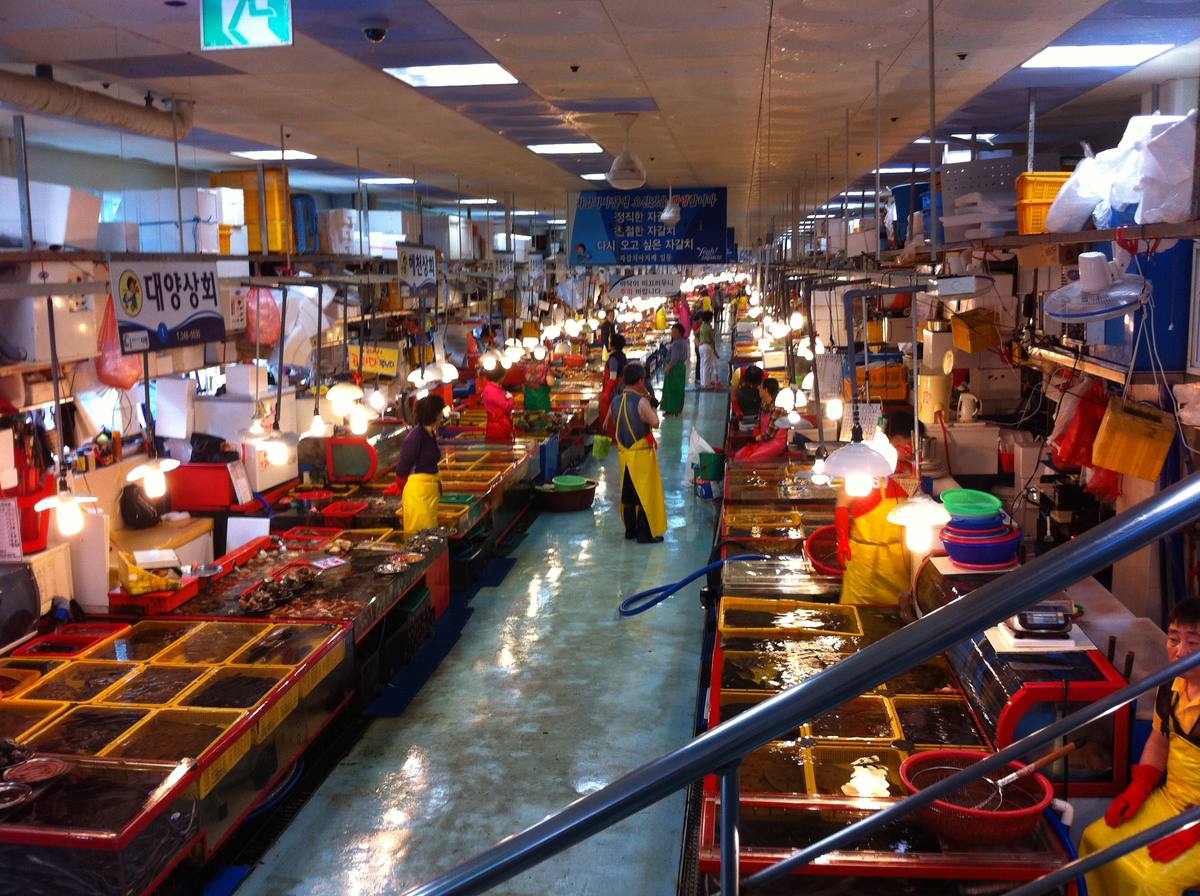
- ›The Live-Fish Hall on the First FloorStep inside the gull-winged main building and the entire first floor is a live-fish hall: tanks and basins running away on both sides of the aisle, with a numbered stall and a knife-ready vendor at every one.
More
The main building was completed in August 2006 as a modernization project: two basement levels and seven floors, with live fish on the first, sashimi restaurants on the second, and an observation deck on the seventh. Asking prices and haggling is the basic grammar here, which can feel daunting the first time — in practice, telling the vendor how many people are eating is enough, and they will size the order for you. The range runs from white fish to abalone, spoon worms, and live octopus, and whatever you pick is cleaned and packed on the spot.
- ›The Chojang-jip UpstairsCarry the fish you just bought downstairs up one flight and you reach a row of restaurants that will serve it to you at a table. This relationship between two floors is what makes Jagalchi Jagalchi.
More
These are called chojang-jip, after the red chili-vinegar dipping sauce. Since you already paid for the fish downstairs, the restaurant charges a per-person table fee for the side dishes and setting, and usually a separate cooking fee for the maeuntang, the spicy stew made from what is left of the fish. Prices vary by shop and change often, so it is worth confirming both the table fee and the stew fee before you sit down. A window seat looks out over the boats of the South Port.
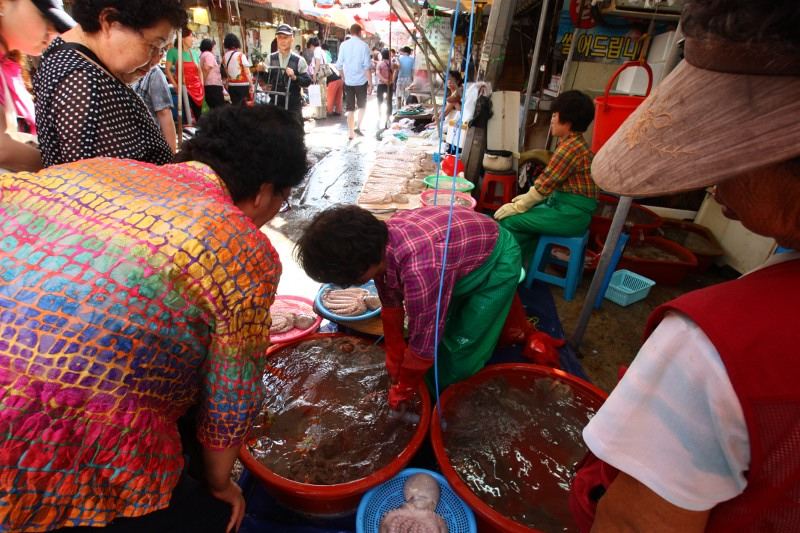
- ›The Open-Air Stalls and the Jagalchi AjumaeThe stall street that runs along the water outside the main building. Vendors on low stools gutting fish and changing the water in their basins — this is what the market looked like before there was a building at all.
More
The phrase "Jagalchi ajumae" came from this pavement, where war widows and displaced women set up stalls to survive, and most of the stallholders here are still women. The indoor hall and this outdoor row are two different spaces, so don't let the building on the map make you miss the street. If you want a photograph, ask first — this is a workplace before it is a sight.
- ›The Kkomjangeo (Hagfish) AlleyAn alley along the Chungmu Haean market where the smell of hagfish grilling over briquette fires fills the whole lane. It is also where locals most often sit down when they come to Jagalchi.
More
Kkomjangeo is the local name for the hagfish. The alley owes its existence to the great Busan Station fire of 1953: restaurants that cooked with open flame relocated here from the burnt-out district, and the grill alley settled in. If raw fish is not for you, this is the easiest way to experience Jagalchi.
- ›The Seventh-Floor Observation DeckThe top floor of the main building looks out over the whole South Port. From here you can read at a glance the relationship between the water packed with fishing boats and the market standing on ground reclaimed from it.
🚶 Self-Guided Walk
- 1Jagalchi Station, Exit 10Leave Exit 10 at Jagalchi Station on Line 1 and walk about six minutes toward the water to reach the edge of the market. Coming from Nampo Station Exit 2 takes about the same time.💡 The market closes on the first, third, and fifth Tuesday of the month — check this before you fix your Busan itinerary.
- 2The Open-Air Stall StreetBefore going inside, walk the row of open-air stalls along the water. Fish being cleaned, basins of seawater, prices called out from a stool — this is the market's original face.
- 3The Live-Fish Hall, First FloorEnter the gull-winged main building and choose your fish on the first floor. Tell the vendor how many are eating and they will size the order and clean it for you.💡 Ask prices at a few stalls before you commit — the bargaining goes much easier that way.
- 4The Chojang-jip on the Second FloorCarry your fish up to the second floor and have it served at a table. Expect a per-person table fee, with a separate cooking fee if you order the maeuntang stew.💡 Prices differ by shop and change often — confirm the table fee and the stew fee before you sit down.
- 5The Dried Seafood LaneAfter the meal, head out into the dried seafood lane. Dried squid, laver, and anchovies are light and keep well, which makes them the easiest thing here to carry home.
- 6The Hagfish Alley (around Chungmu Haean Market)The lane where hagfish — kkomjangeo — is grilled over briquettes. It formed after the great Busan Station fire of 1953, when restaurants that cooked with open flame relocated here.💡 If you have already had the sashimi, come back in the evening for a single grilled plate.
- 7The Seventh-Floor Observation DeckFinish by going up to the seventh floor for the view over the South Port — the harbor full of fishing boats and the market built on land taken from it, in a single frame.
🧭 Visitor Info
💡 Good to Know
- The market closes on the first, third, and fifth Tuesday of each month — note that the second and fourth Tuesdays are normal business days.
- Doors open at 05:00 and the early morning is the liveliest time — but you cannot watch a dawn auction here. The wholesale auctions are run by a separate institution, the Busan Cooperative Fish Market.
- The indoor hall and the outdoor stall street are two different spaces — walk both. The nearby Sindonga Fish Market is also a separate market, opened in 1987.
- Upstairs, the per-person table fee and the stew cooking fee vary by shop and change often. Ask about both before sitting down and there will be no surprises at the end.
- The Jagalchi Festival, first held in 1992, takes place every October. Its slogan is pure Busan dialect: "Oiso! Boiso! Saiso!" — Come! Look! Buy!
🗺 Pair Your Visit
Jagalchi Market is a living document of Busan as the provisional capital during the Korean War (1950–53) and of the postwar economy of ordinary people. In a port city flooded with refugees, a market stall was a means of survival, and the labor of women who had lost the family breadwinner sustained the market — which also makes it a case study in the modern history of women's work. One caution for exam questions: do not connect it directly to the opening of the port in 1876. Busan's treaty port grew on the site of the Choryang Waegwan, while Jagalchi is a twentieth-century market that formed after the South Port was reclaimed in the 1930s.