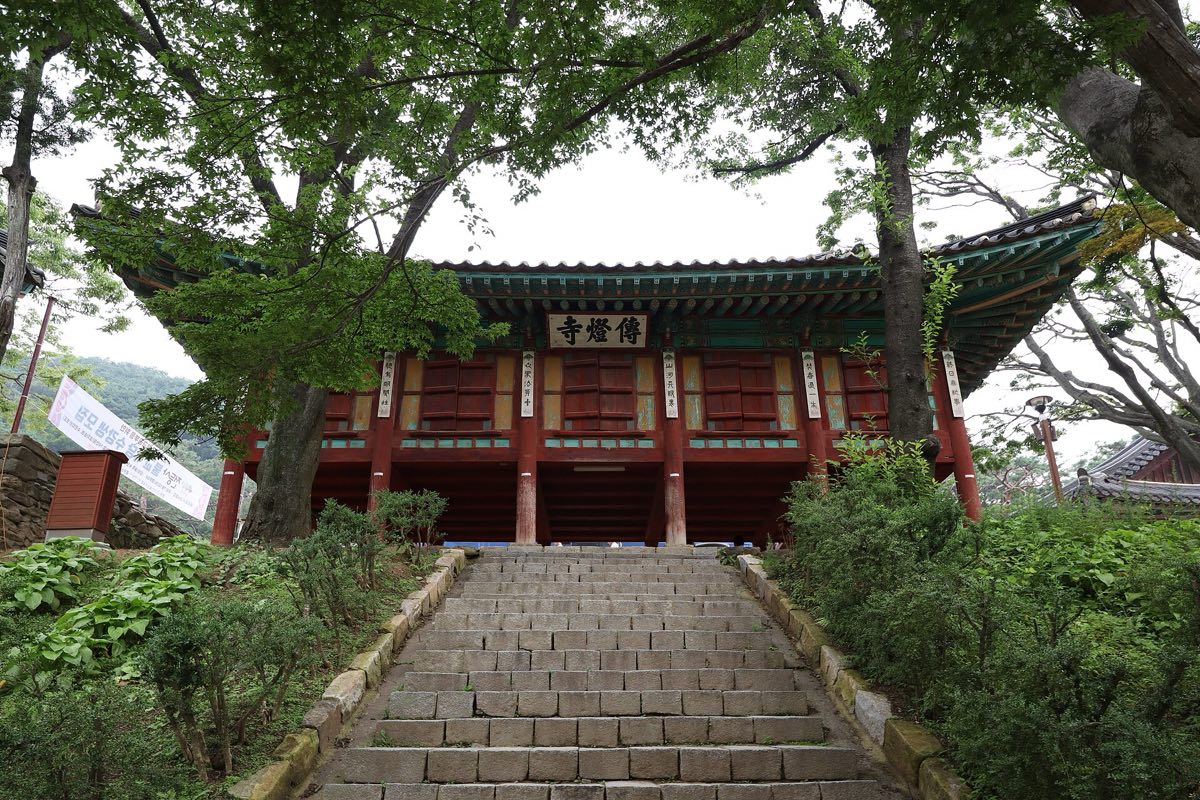
Jeondeungsa Temple
傳燈寺A temple wrapped in a fortress, and the wall that saved the royal annals
Jeondeungsa is unusual in that a mountain fortress wraps the whole temple. That fortress is Samnangseong, where Yang Heon-su drove off French troops during the French campaign of 1866. Inside the walls stood the Jeongjoksan archive, which held the Annals of the Joseon Dynasty, so the victory was also a victory that saved the Annals. The temple is traditionally said to have been founded in 381 by the monk Ado, though no contemporary record supports it.
📖 The Story
Its first name was Jinjongsa. It became Jeondeungsa in 1282, after Queen Jeonghwa, consort of King Chungnyeol of Goryeo, donated a jade lamp along with a set of the Buddhist canon. Jeondeung means to pass on the lamp of the dharma. That a queen under Yuan domination gave a lamp to a temple and that the lamp became the temple's name shows just how close Buddhism and the royal house were in late Goryeo. The main hall standing today was begun in 1615 and finished in 1622.
In the autumn of 1866 a French fleet occupied Ganghwa Island. Yang Heon-su led a force built around musketeers, crossed the Ganghwa strait by night and got inside Samnangseong. Korean troops with the wall at their backs met the French outside it, and the French pulled back. That engagement turned the course of the campaign. The Annals of the Joseon Dynasty, held in the Jeongjoksan archive inside the walls, came through untouched because of it. Just as a single surviving set from the Jeonju archive carried the Annals through the Imjin War, here a single wall did the same work.
✦ Highlights
- ›Daeungbojeon HallThe main hall, begun in 1615 and completed in 1622. It is designated a Treasure.
More
It was rebuilt after a fire in the reign of Gwanghaegun. Architectural historians treat it as an example of mid-Joseon timber joinery, and the ornament inside and out is dense. Do not forget to look up at the four corners of the eaves. That is where the temple's most-told carving is.
- ›The naked figures under the eavesWooden carvings of naked figures holding up the roof at each of the four corners of Daeungbojeon.
More
The story goes that the master carpenter in charge of the rebuilding carved the woman who had betrayed him and run off, so that she would carry the weight of the roof forever. It is the best known tale in the temple, but it is only a tale; others read the figures as rakshasa demons or monkeys set there to guard the dharma. Either way, the posture at all four corners is the same.
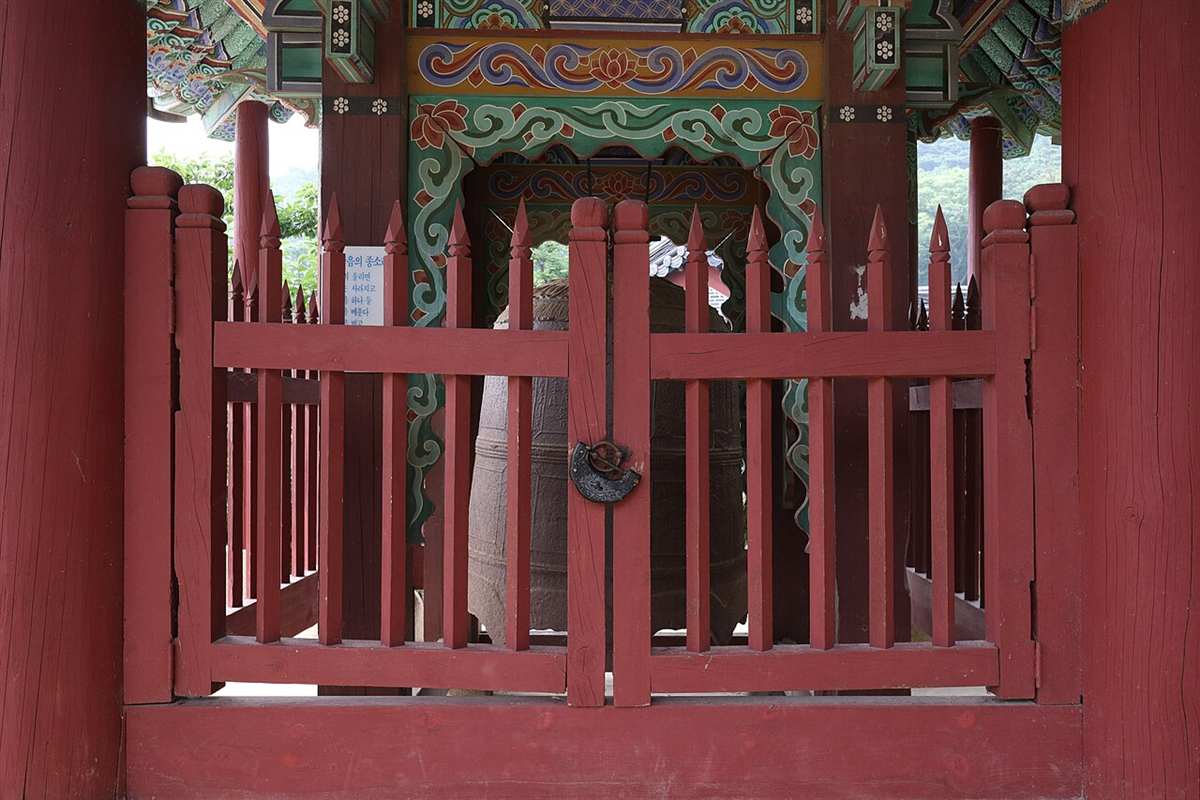
- ›The bronze bellA Treasure hanging in the bell pavilion. It is a bell made in China that has come down to this temple.
More
It lacks the sound tube and the flying-apsara relief common on Korean bells and has a lattice pattern banding the body, so side by side the shape is noticeably different. It is said to have been requisitioned under Japanese rule and returned after liberation, though the details vary between sources. The pavilion is locked, so you see it through the slatted railing.
- ›Samnangseong and the site of the Jeongjoksan archiveThe fortress that wraps the temple. Inside it stood the archive holding the Annals of the Joseon Dynasty and a hall for the royal genealogy.
More
The History of Goryeo records a tradition that Dangun had his three sons build it, which is where the name Samnangseong comes from. The other name, Jeongjoksan, comes from three peaks said to look like the three feet of a cauldron. The Annals were moved here from the Manisan archive in the mid-seventeenth century, and Yang Heon-su's victory in 1866 kept them safe.
- ›The Yang Heon-su victory monumentA stone marking the 1866 battle at Jeongjoksan fortress. It stands on the wall path near the east gate.
More
The French campaign of 1866 is remembered first as the incident in which France carried off the books of the Outer Gyujanggak, but militarily it also contained a battle that made Joseon's attacker withdraw, and it happened here. Seeing the plundering at the Goryeo palace site and the victory at this monument on the same trip lines up what happened that autumn in a single sentence.
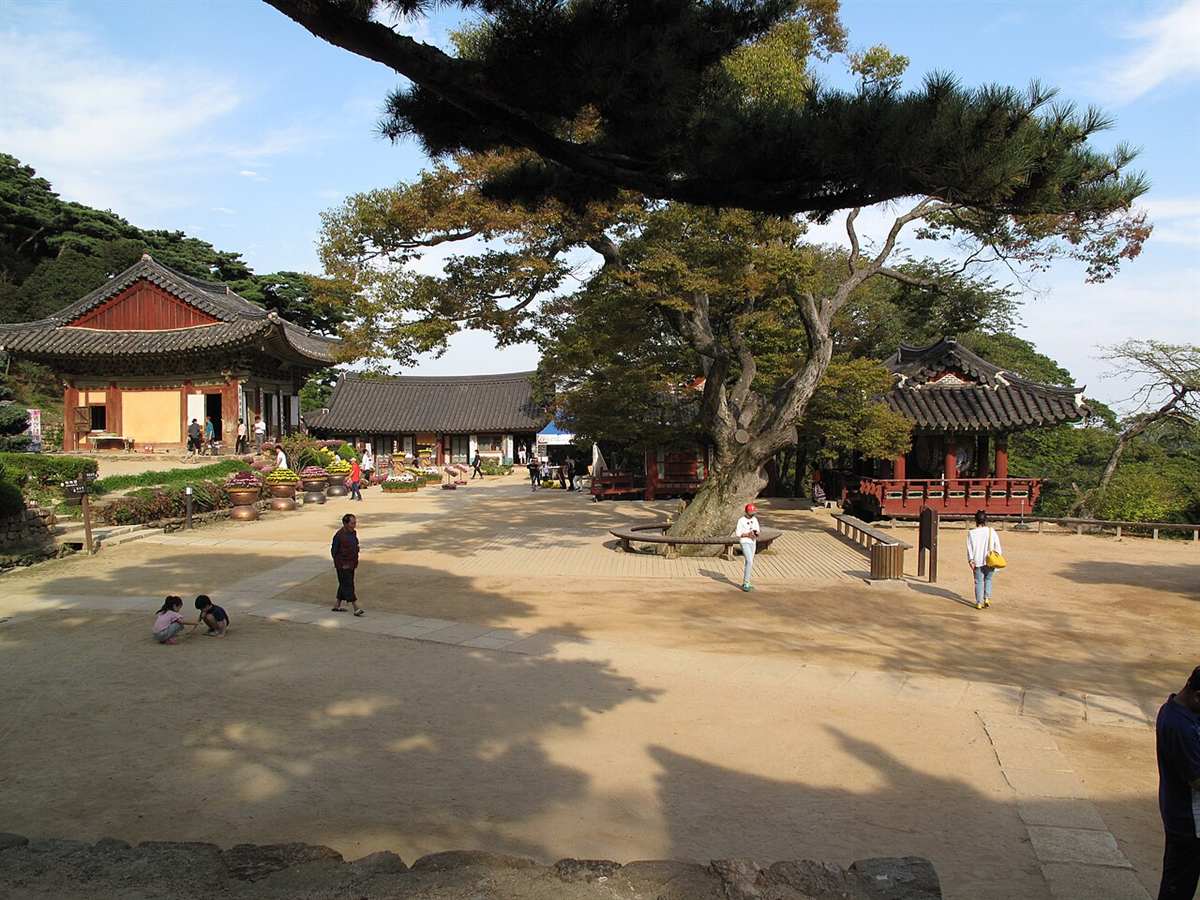
🚶 Self-Guided Walk
- 1The south gate (Jonghaeru) or the east gateYou pass through a fortress gate to reach the temple. Entering a fortress before a temple is what marks this place out.💡 The east gate is closer to the car park; the south gate suits walking the wall.
- 2Daejoru PavilionThe pavilion standing across the approach to the main hall. You pass beneath it into the courtyard.
- 3Daeungbojeon HallThe temple's central hall. Stand in the courtyard and look for the carved figures at the four corners of the eaves.💡 There is one at every corner, so walk right round the hall.
- 4Yaksajeon Hall and the bell pavilionThe Treasure-designated hall beside Daeungbojeon, and the bell seen through the slatted railing.
- 5The site of the Jeongjoksan archiveWhere the Annals were kept. A reconstructed building stands there now.💡 Knowing that this is what was saved in 1866 changes the impression entirely.
- 6The Samnangseong wall path and the victory monumentFollow the wall and you reach the monument. Temple and battle sit inside one enclosure.💡 Parts of the wall path are unpaved, so choose your shoes accordingly.
🧭 Visitor Info
💡 Good to Know
- You pass the fortress gate before the temple. You buy your ticket at the Samnangseong office and enter through the walls.
- Admission is around 4,000 won and it changes, so check at the ticket office.
- The founding date of 381 is a tradition. You will often see the temple called the oldest in Korea, but no contemporary record supports it.
- Ganghwa Island has no subway. Take an intercity bus from Seoul to the Ganghwa terminal, then continue from there.
- Allow about two hours if you walk the wall as well. The temple alone takes an hour.
🗺 Pair Your Visit
The most important exam material at Jeondeungsa is the French campaign of 1866. In that episode, in which French forces occupied Ganghwa Island and carried off the books of the Outer Gyujanggak, Yang Heon-su led a force built around musketeers into Samnangseong, also called Jeongjoksan fortress, and drove the French back. The Annals of the Joseon Dynasty, held in the Jeongjoksan archive inside the walls, survived because of that victory. The temple's name dates from 1282, when Queen Jeonghwa, consort of King Chungnyeol of Goryeo, donated a jade lamp, and Daeungbojeon, Yaksajeon and the bronze bell are all designated Treasures.