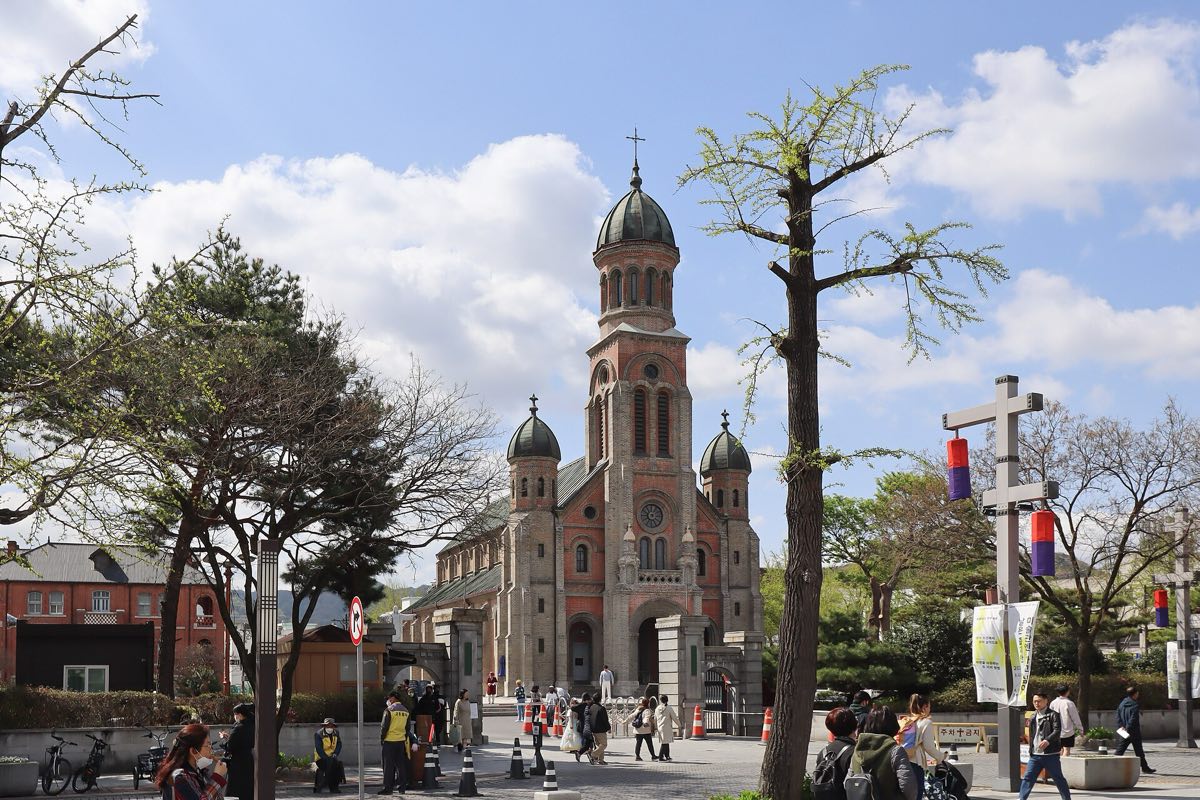
Jeondong Catholic Cathedral
A red-brick cathedral raised on the ground where Korea's first martyrs died
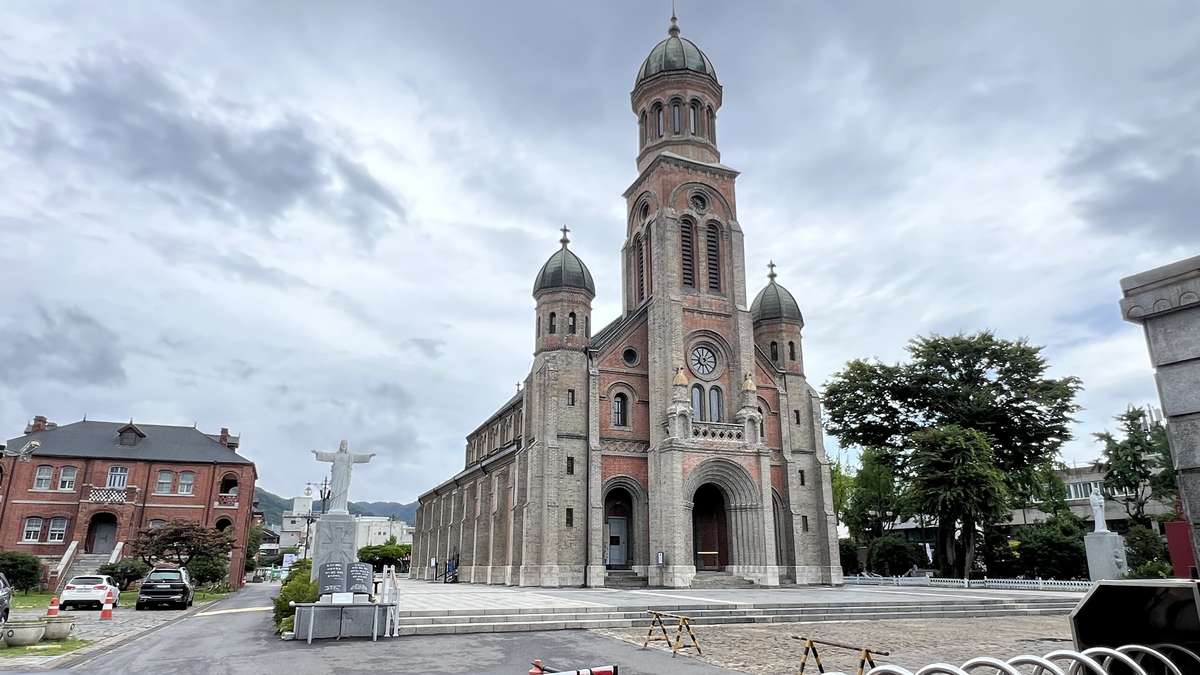
Jeondong Catholic Cathedral stands at the entrance to Jeonju's Hanok Village, facing Gyeonggijeon shrine across a single street. That view — a Western church looking straight at the shrine of the Joseon royal house — is itself a cross-section of Jeonju's layered history. This ground is where Yun Ji-chung and Kwon Sang-yeon were executed in the Sinhae Persecution of 1791, and the building raised over it, begun in 1908 and blessed in 1931, was the first Western-style structure in the Honam region. Romanesque in its bones but crowned with Byzantine-style domes on its bell tower and stair towers, it looks strikingly foreign among the tiled hanok roofs around it.
📖 The Story
The story begins more than a century before the building. In 1791 Yun Ji-chung (baptismal name Paul), a Catholic living in Jinsan, burned the ancestral tablets and held no Confucian rites when his mother died; his cousin Kwon Sang-yeon (James) stood with him. In a Joseon that treated ancestral rites as the foundation of the state, this was judged a crime against the moral order, and both men were executed that year — the first martyrs of the Korean Catholic Church. The execution ground of what became known as the Sinhae Persecution (the Jinsan Incident) lay just outside Pungnammun, the south gate of the old Jeonju town wall — the very spot where the cathedral stands today. Ten years later, in the Sinyu Persecution of 1801, Yu Hang-geom (Augustine), remembered as the Apostle of Honam, along with Yu Gwan-geom and Yun Ji-heon, died on this same ground.
The church itself rose only after Korea opened its ports. In 1891 Father Baudounet, the first pastor of the Jeonju parish, bought up land around the martyrdom site, and construction finally began in 1908. The design came from Father Poisnel, the priest-architect behind the interior of Myeongdong Cathedral in Seoul. The exterior was finished in 1914, but fitting-out continued, and the blessing ceremony that marked the true completion was not held until 1931. Some of the granite footing stones and red bricks came from the demolished walls of the old Jeonju town fortress — stone from the wall that once held the martyrs became the footing of the church built in their memory.
Architecturally it is a hybrid: Romanesque at its base, with Byzantine-style domes set on the bell tower and the two flanking stair towers. The round-arched windows and doorways and the walls woven from red and grey brick speak Romanesque; the three rounded domes above them speak another era altogether. As the first Western-style building in the Honam region, it was designated a Historic Site in 1981. On 16 August 2014 Pope Francis beatified Yun Ji-chung and 123 companions — the beatification Mass itself was held at Gwanghwamun Square in Seoul, while Jeondong Cathedral holds the place at the centre of that memory as the ground on which they died.
✦ Highlights
- ›The Red-Brick Facade and the Stones of the Town WallA facade of red brick banded and arched with grey brick. The granite of the footing and some of the bricks came from the demolished walls of the old Jeonju town fortress.
More
The reuse of the wall material is not thrift but the building's whole argument. When the fortress that had held the martyrs of 1791 and 1801 was pulled down after the opening of the ports, its stone and brick became the body of the church raised on the ground where they died. Up close you can read the Romanesque rhythm in the round-arched windows and doorways and in the brick banding that runs across the walls.
- ›Three Towers Under Byzantine DomesA tall central bell tower and two flanking stair towers, each capped with a rounded dome. This Byzantine touch on a Romanesque body gives Jeondong its silhouette, recognisable from far off.
More
Seen head-on, the three domes rise in symmetry and set themselves sharply against the low, long tiled roofs of the hanok village. For photographs, step back into the forecourt so all three towers fit the frame; the view from the Gyeonggijeon side of the street, looking up past the shrine wall, catches two eras of the city in a single shot.
- ›The Martyrdom Ground Outside the Old South GateThe ground itself is the sight. This is the execution field outside Pungnammun, the old south gate, where Yun Ji-chung and Kwon Sang-yeon died in 1791 and Yu Hang-geom and others in 1801.
- ›Face to Face with GyeonggijeonOne or two minutes on foot across the street stands Gyeonggijeon, the Joseon royal shrine. A dynastic sanctuary enshrining the portrait of King Taejo, looking straight at a cathedral of martyrs — a pairing you will find only in Jeonju.
🧭 Visitor Info
💡 Good to Know
- This is a working parish church before it is a tourist site. Keep your voice down in the grounds and inside, and do not enter while a service is in progress. Photograph carefully, avoiding people at prayer and the sanctuary.
- If seeing the interior matters to you, call the parish (+82-63-284-3222) in advance to ask whether it is open and when Mass is held. Access has been limited to parishioners in the past, and posted schedules change often.
- Come in the late afternoon, after Gyeonggijeon: the low sun deepens the red brick and the building photographs at its best. After dark, remember the surroundings are a lived-in neighbourhood and a working parish — walk quietly.
🗺 Pair Your Visit
Two landmark persecutions of late Joseon overlap on this one patch of ground. The Sinhae Persecution of 1791 (the Jinsan Incident) — Yun Ji-chung and Kwon Sang-yeon burning the ancestral tablets and refusing Confucian rites — produced Korea's first Catholic martyrs; the Sinyu Persecution of 1801 saw Yu Hang-geom and others executed and led on to the Hwang Sa-yeong silk-letter affair. Exam questions often turn on telling the two apart by date and trigger. Note that the Byeongin Persecution of 1866 has no connection to this site.