Ojukheon House
烏竹軒A house ringed by black bamboo, where Shin Saimdang and Yulgok were born
Ojukheon is the house where Shin Saimdang gave birth to her son Yi I, better known as Yulgok. Its name comes from the ojuk, the black bamboo that rings the walls. Built in the 15th century, it is counted among the oldest surviving dwellings in Korea and was designated a Treasure in 1963. The house appears on the front of today's 5,000 won note behind Yi I's portrait, and the figure on the 50,000 won note is his mother, Shin Saimdang.
📖 The Story
What makes this house interesting is not the building but the line of ownership. Built by the Choi family of Gangneung, it passed to Choi Eung-hyeon's son-in-law Yi Sa-on, then to Yi Sa-on's son-in-law Shin Myeong-hwa, and then to Shin Myeong-hwa's son-in-law Gwon Cheo-gyun. All four transfers ran through daughters and their husbands. Inheritance in Joseon looks, from a distance, like something that always went to sons; this single house records the fact that through the early Joseon period property was in practice divided without much regard to whether the child was a son or a daughter. Even the name Ojukheon comes from the pen name of Gwon Cheo-gyun, the last of those heirs. The house did not give the man his name; the man gave the house its name.
Shin Myeong-hwa's daughter, Shin Saimdang, gave birth to her son in the annex of this house in 1536. She is said to have dreamed of a black dragon flying in from the sea, and so the room is called Mongnyongsil, the dragon dream room. The child born there, Yi I, became one of the two pillars of Joseon Neo-Confucian thought alongside Yi Hwang, and the two men's teachings later divided into the Giho and Yeongnam schools that formed the intellectual roots of Joseon's factional politics. In 1788 King Jeongjo ordered a pavilion built here to hold Yi I's handwritten Gyeongmong yogyeol and the inkstone he had used as a boy. A king had a building put up at the birthplace of a subject.
✦ Highlights
- ›MongnyongsilThe room where Shin Saimdang gave birth to Yi I in 1536. The name is said to come from her dream of a black dragon flying in from the sea.
More
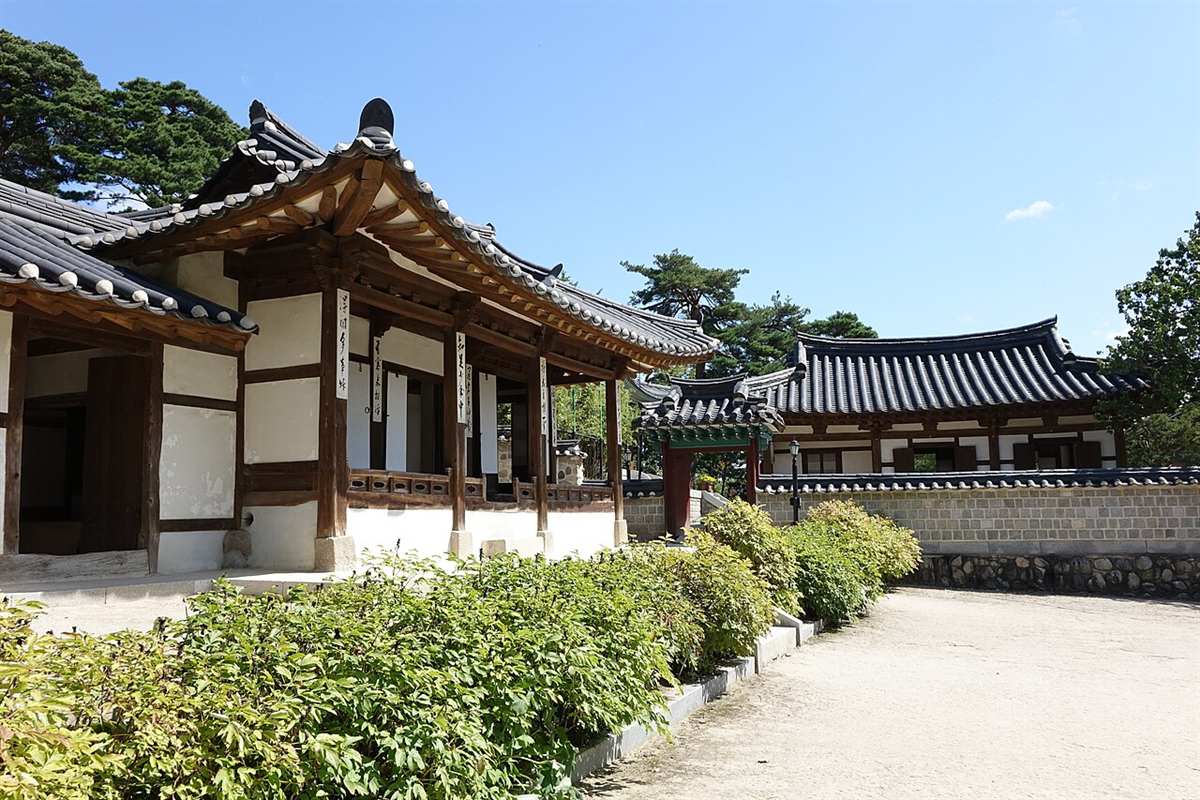
The main hall of Ojukheon is a modest building, three bays across and two deep. If you are looking for something grand you will walk straight past it, so it is better to stand at the veranda first and take the measure of a single room. That the birthplace of one of Joseon's defining scholars is only this large is half of the impression the house leaves.
- ›The timber frame of the main hallA hip-and-gable roof carried on a jusimpo bracket system with ikgong elements mixed in. Architectural historians treat it as an early surviving example of an early Joseon dwelling.
More
Jusimpo, which places brackets only above the columns, is the older method inherited from Goryeo; ikgong is the simpler system that took hold under Joseon. That both appear in one building is what makes this house a reference point when dating others. Look up under the eaves and you will see the joinery sitting directly on the column heads and nowhere else.
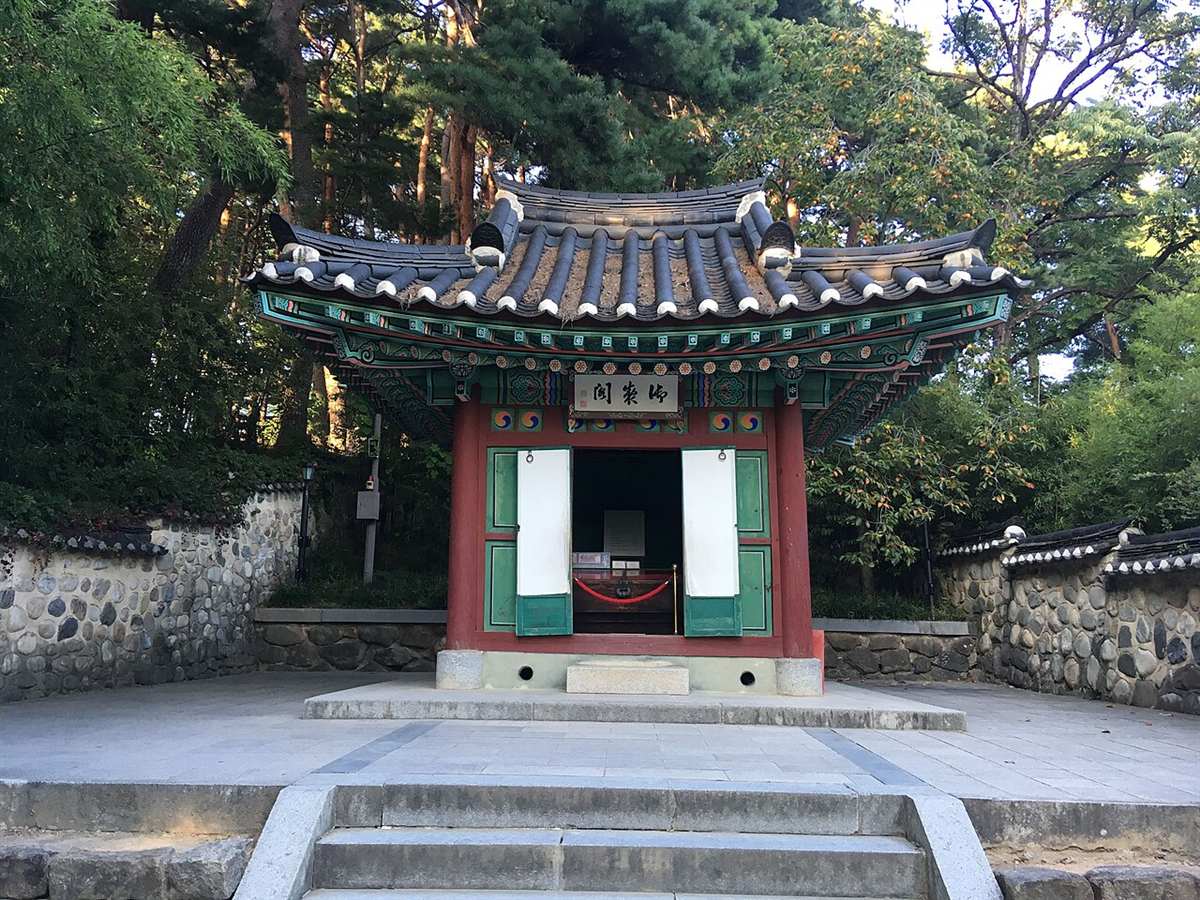
- ›EojegakA pavilion built in 1788 by order of King Jeongjo. It holds Yi I's handwritten Gyeongmong yogyeol and the inkstone he used as a child.
More
A building raised at a subject's birthplace on a king's direct instruction is an unusual thing. It also means Jeongjo chose to leave Yi I's belongings where he was born rather than carry them off to the palace. With its red columns, green shutters and painted dancheong, this is the one structure here whose colours differ from the white-walled dwellings around it.
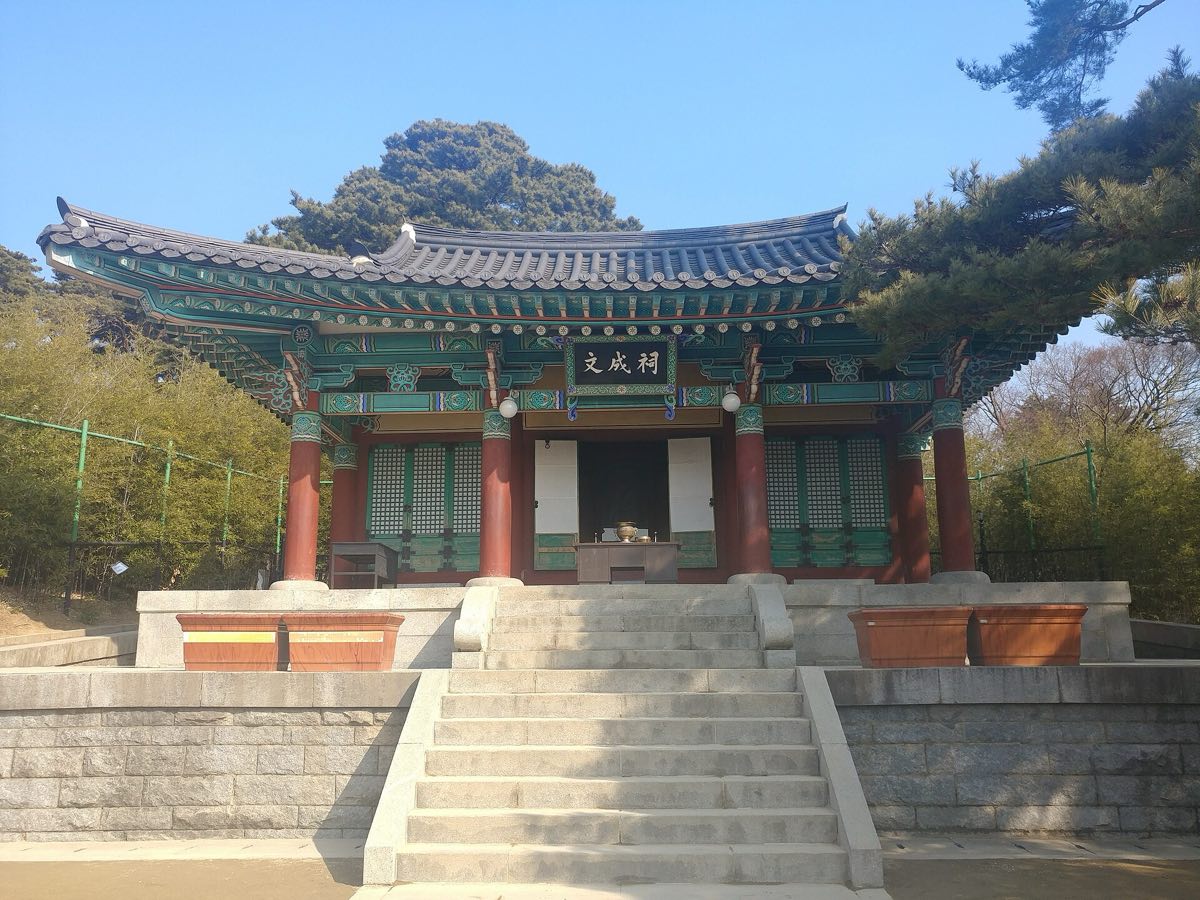
- ›Munseongsa ShrineThe shrine holding Yi I's portrait. It takes its name from his posthumous title, Munseong, and was built during the restoration works of the 1970s.
More
A posthumous title sums up a life in two characters awarded after death. Mun means learning, seong means completion. The shrine itself is a twentieth-century building and not a piece of architectural heritage, but standing with a pine wood at its back it is the best spot in the grounds for a photograph.
- ›The Yulgok plum treeA plum tree thought to have been planted when Ojukheon was built, putting its age at roughly 600 years. It was designated a Natural Monument in 2007.
More
Shin Saimdang and Yi I are said to have tended it themselves. Go with high expectations, though, and you may be disappointed. From 2017 the tree declined sharply, most of it has died back, and only the surviving branches still flower. Gangneung is raising successor trees to carry the line on. It is better understood as a chance to see how a tree that has lived six hundred years grows old.
🚶 Self-Guided Walk
- 1Jagyeongmun GateThe gate into the grounds. Its name comes from Jagyeongmun, a text Yi I wrote to hold himself to account.💡 It stands just past the ticket office. From here the black bamboo runs along both sides of the path.
- 2The main hall and MongnyongsilThe annex holding the room where Yi I was born. Only three bays across, it is easy to hurry past.💡 From the veranda, look up once at the joinery under the eaves.
- 3The Yulgok plum treeThe plum tree at the corner behind the main hall, a Natural Monument roughly 600 years old.💡 Even in late March, when it blooms, the flowers appear only on the surviving branches.
- 4Munseongsa ShrineThe shrine holding Yi I's portrait, with a pine wood standing behind it like a folding screen.
- 5EojegakThe pavilion King Jeongjo had built, holding the Gyeongmong yogyeol and the inkstone.💡 It is the only painted building here, so it stands out from a distance.
- 6Ojukheon Municipal MuseumThe museum inside the same walls, showing local folk material and finds from the Gangneung area.💡 One ticket covers both. On 1 January and on the days of Seollal and Chuseok, only these indoor galleries close.
- 7The black bamboo groveThe grove that gave the house its name. The stems really are black.💡 Follow the wall on your way out and you will meet it last.
🧭 Visitor Info
💡 Good to Know
- The grounds stay open until 18:00, but the last admission is at 17:00. Allow an hour's margin.
- Gangneung has no subway. Come from KTX Gangneung Station by city bus or taxi.
- The grounds are close to level and not large, so an hour or so covers the house and the museum together.
- Gyeongpo Lake is not within walking distance. If you are pairing Ojukheon and Gyeongpodae in one day, move between them by bus or taxi.
🗺 Pair Your Visit
Ojukheon is the house where Shin Saimdang and Yi I were born. Yi I formed one of the two pillars of Joseon Neo-Confucian thought alongside Yi Hwang: where Yi Hwang put the ruler's own self-cultivation first in his Seonghak sipdo, Yi I stressed the reform of actual institutions in his Seonghak jibyo and Dongho mundap. Their teachings later divided into the Giho and Yeongnam schools, which became the intellectual roots of Joseon's factional politics. That the house passed four times through daughters and their husbands is itself evidence of early Joseon inheritance practice.