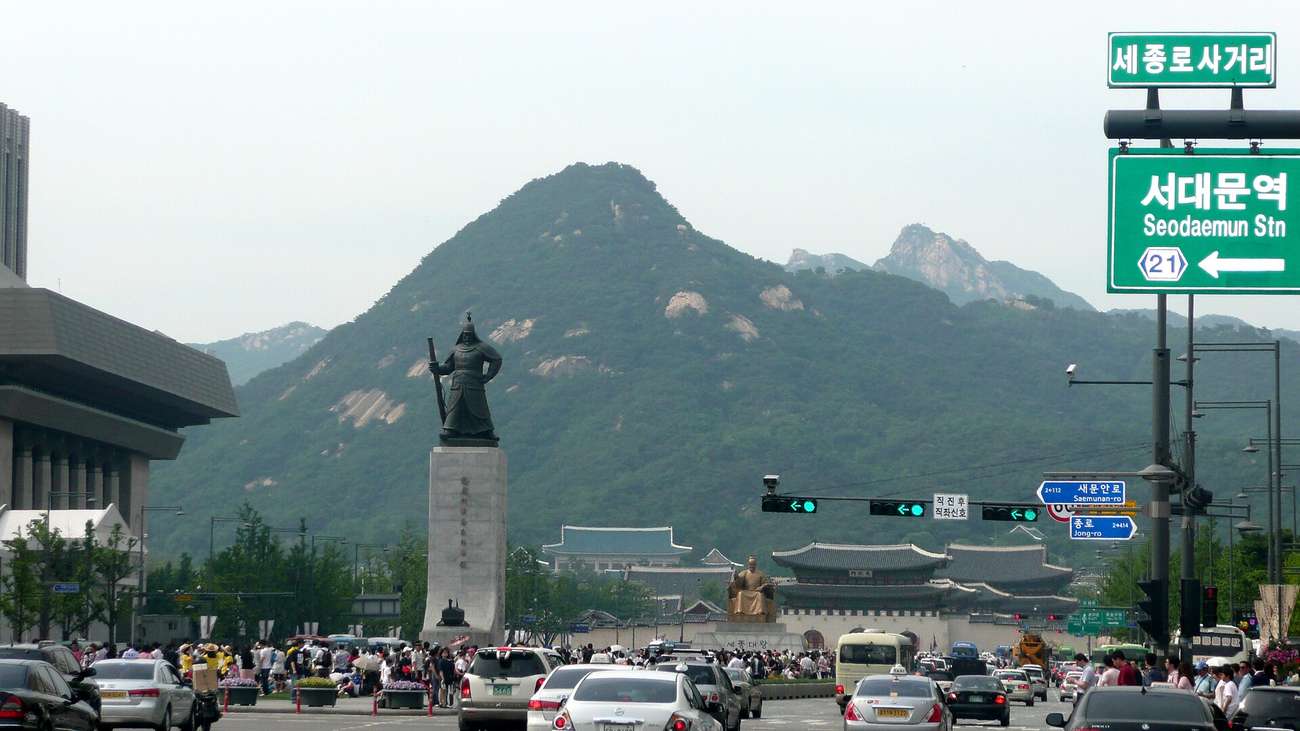
Gwanghwamun Square and Sejong-daero
光化門Admiral Yi Sun-sin and King Sejong, standing on Joseon's avenue of ministries
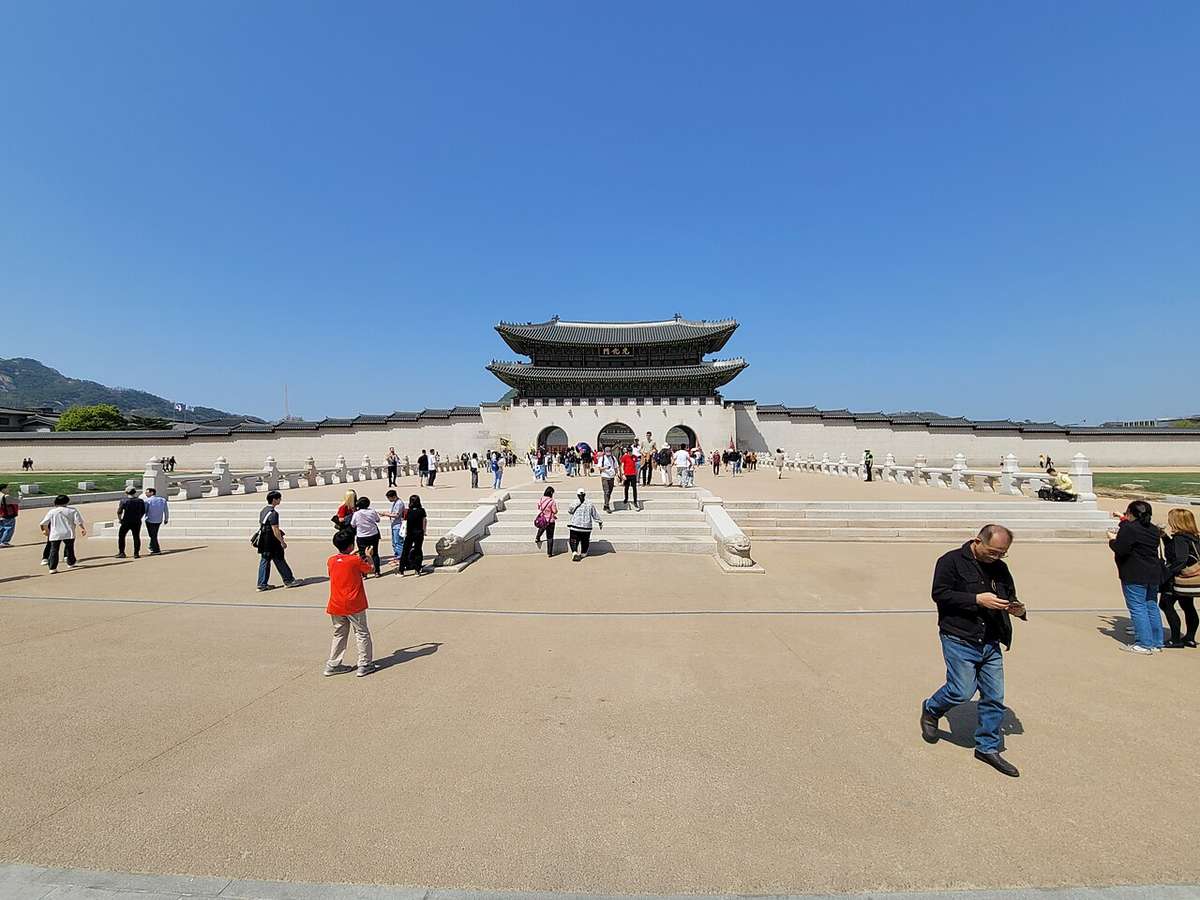
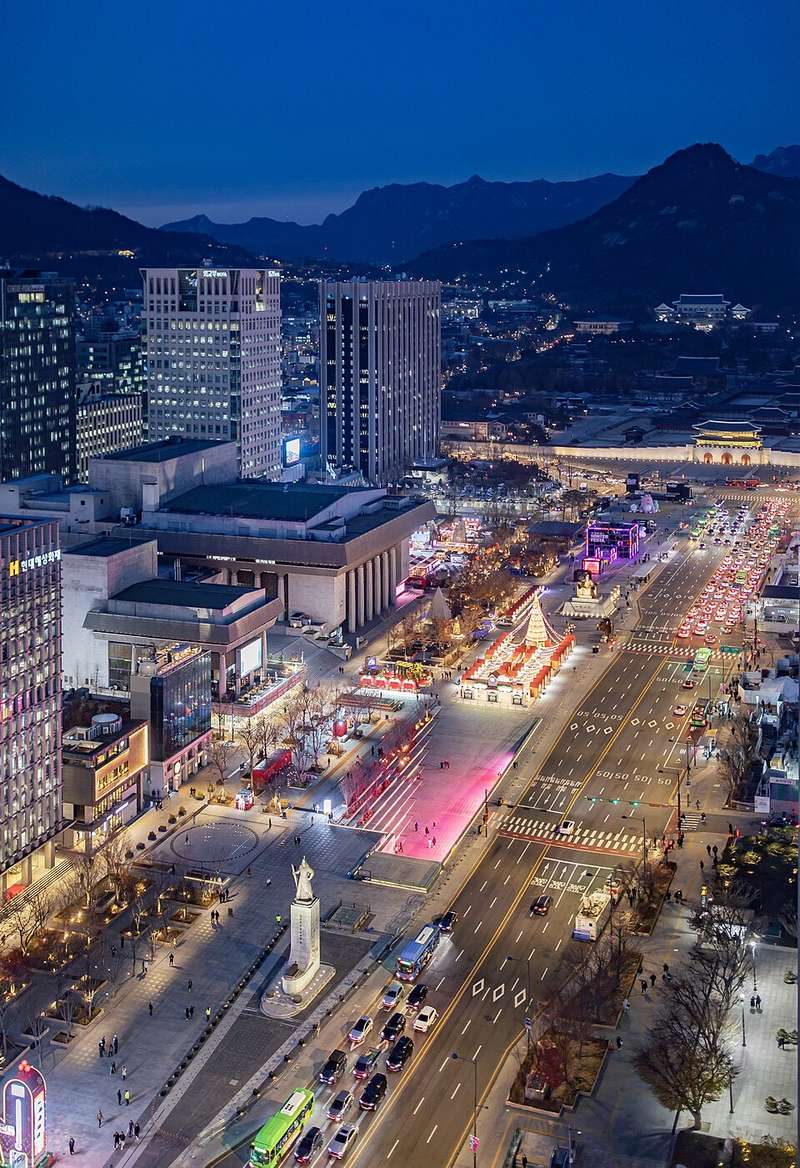
Gwanghwamun Square lies in the middle of Sejong-daero, the avenue running straight up to Gwanghwamun, the main gate of Gyeongbokgung. With Bugaksan behind them, the statues of Admiral Yi Sun-sin and King Sejong stand one after the other, and almost every visitor to Seoul passes this way: it is the face of the city. The avenue was the center of the nation six hundred years ago too. In Joseon times the State Council and the Six Ministries lined both sides, giving it the name Yukjo-geori, "the street of the Six Ministries", and when the square was rebuilt the sites of those offices came out of the ground again. In 2022 the square doubled in size, and in 2023 the terrace in front of Gwanghwamun was restored after a hundred years, making a continuous walk all the way into the palace.
📖 The Story
When Gyeongbokgung was built in 1395, Joseon laid out a broad avenue in front of the palace and placed the offices that ran the country on either side. The State Council, the highest governing body, the Six Ministries of Personnel, Taxation, Rites, War, Justice and Works, and the Office of the Inspector-General, which watched over officials, all gathered on this street. It was the central axis of the capital, designed so that the palace where the king lived and the offices that governed the country ran in a single line.
Under Japanese rule the government buildings were torn down, and the broad raised terrace in front of Gwanghwamun, the woldae, disappeared when tram tracks were laid. After liberation the street became a wide road named Sejong-ro, and in 1968 the statue of Admiral Yi Sun-sin went up in the middle of it. In 2009 a square was created down the center of the road, and on Hangeul Day that year the statue of King Sejong was unveiled.
In 2021, during work to rebuild the square, the sites, walls and drains of Joseon offices including the Office of the Inspector-General, the Military Council and the Ministry of Justice emerged from the ground. Most were covered again to protect them, but some were left visible as they were excavated. The enlarged square reopened in August 2022, and in October 2023 the terrace in front of Gwanghwamun was restored, so you can now walk up from the square right to the palace gate. Joseon's avenue of ministries has become a square for the people.
✦ Highlights
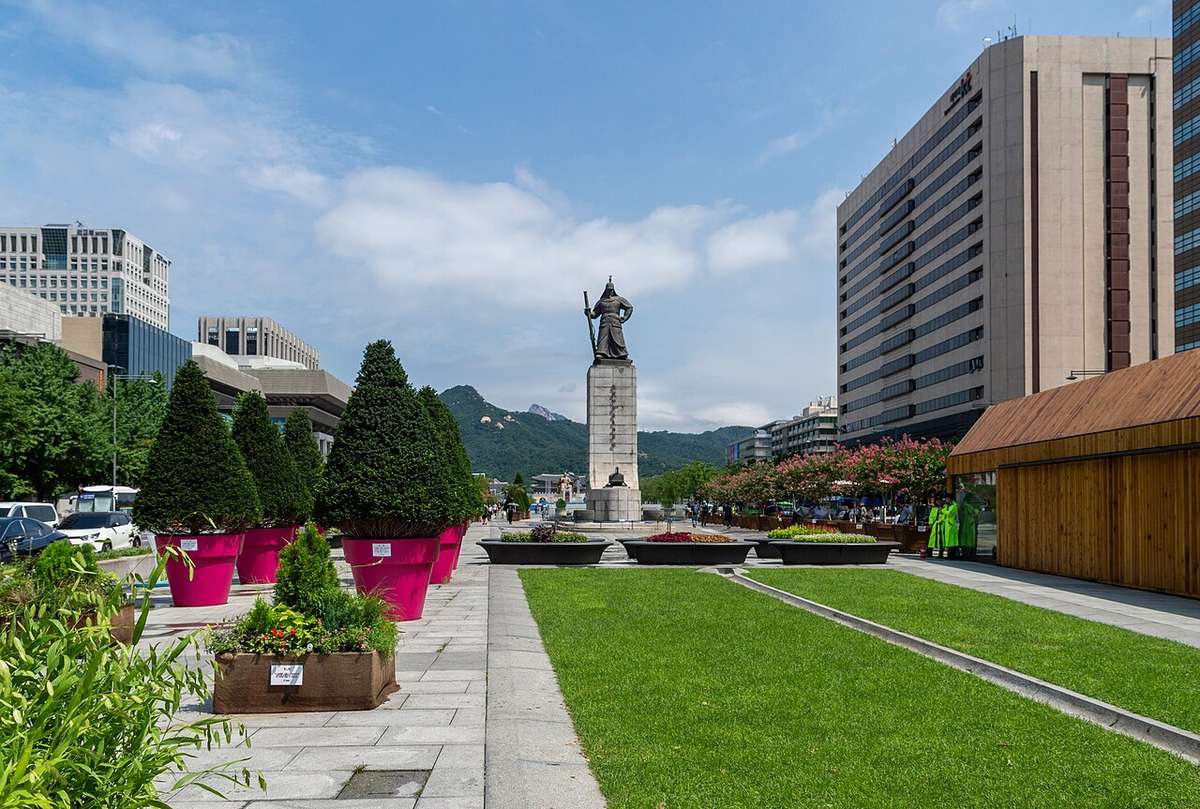
- ›The Yi Sun-sin statue and the Myeongnyang fountainThe large statue at the south end of the square, erected in April 1968, with Bugaksan and Gwanghwamun at its back and a fountain and victory monument commemorating the Battle of Myeongnyang in front.
More
During the Imjin War, Yi Sun-sin's navy, led by its turtle ships, defeated the Japanese fleet again and again, beginning with the Battle of Hansando in 1592, and at Myeongnyang in 1597 he held off the Japanese with just twelve ships. One reading of the statue facing south, with Gwanghwamun at its back, is that it stands for the general guarding the nation. The "Story of Admiral Yi" exhibition beneath the square tells his battles in more detail, with models such as a turtle ship. From the foot of the statue, look north and a six-hundred-year axis runs in a single line through Gwanghwamun to Bugaksan.
- ›The King Sejong statue and scientific instrumentsThe statue of King Sejong unveiled on Hangeul Day, 9 October 2009. In front lie the text of Hunminjeongeum and models of a sundial, rain gauge and armillary sphere, bringing his achievements together in one place.
More
Sejong created Hunminjeongeum in 1443 and promulgated it in 1446, and had scientific instruments such as the rain gauge and the hemispherical sundial made. Steps behind the statue lead down to the exhibition halls beneath the square, "The Story of King Sejong" and "The Story of Admiral Yi". Sejong was born in Seochon, just west of this avenue, so walking the two together traces his life from birthplace to statue. You can study the instrument models in front of the statue up close.
- ›Excavated remains of the avenue of ministriesPart of the Joseon office sites and drains found during the square's rebuilding in 2021, displayed as they were excavated. The ground itself testifies that this street was Joseon's "avenue of the Six Ministries".
More
When Gyeongbokgung was built in 1395, Joseon placed offices along both sides of the street in front of it: the State Council, the Six Ministries of Personnel, Taxation, Rites, War, Justice and Works, and the Office of the Inspector-General, which watched over officials. The rebuilding uncovered the sites, walls and drains of the Inspector-General's office, the Military Council and the Ministry of Justice; most were covered again for protection, but some were left on view. Remember that Joseon's offices still lie beneath the paving you walk on, and the claim that this street has been the nation's center for six hundred years becomes real.
- ›Gwanghwamun's woldae terraceGwanghwamun's woldae, the broad raised terrace in front of the gate. Lost when tram tracks were laid under Japanese rule, it was restored in October 2023 after a hundred years.
More
The woldae was where the king met his people and held ceremonies. During the excavation, the old tram tracks laid over the damaged terrace were actually uncovered. With its restoration you can walk without a break from the square across the terrace to Gwanghwamun, and a new name board for the gate was unveiled the same day. The inside of Gyeongbokgung is covered in detail on this site's palaces page.
🚶 Self-Guided Walk
- 1Cheonggye Plaza · south end of the squareStart at the south end, where Cheonggyecheon begins, looking north toward Bugaksan.
- 2The Yi Sun-sin statuePass the Myeongnyang fountain and the victory monument to stand before the statue.
- 3The King Sejong statue · underground exhibitionsSee the instrument models in front of the statue, then go down the steps behind it to the exhibitions.
- 4Avenue of ministries remainsLook for the excavated office sites on the western side.
- 5Gwanghwamun woldae · GwanghwamunCross the restored terrace to the palace gate, and continue into Gyeongbokgung.💡 Time your visit for the gatekeeper changing ceremony in front of Gwanghwamun, which adds one more sight.
🧭 Visitor Info
💡 Good to Know
- Events and rallies are often held on the square at weekends; on busy days some subway exits may be closed.
- Gwanghwamun and Bugaksan look beautiful lit up after dark; pair it with Gyeongbokgung's night openings when they are on.
- Seochon to the west, Gyeongbokgung to the north and Insadong to the east are all within walking distance, making this a good starting point for exploring central Seoul on foot.
🗺 Pair Your Visit
Under Joseon's central government, the Six Ministries of Personnel, Taxation, Rites, War, Justice and Works handled the work beneath the State Council, the highest body, while the Three Offices, including the Office of the Inspector-General, checked those in power. King Sejong created (1443) and promulgated (1446) Hunminjeongeum and had scientific instruments such as the rain gauge and the hemispherical sundial made. Yi Sun-sin defended the seas with the victory at Hansando (1592) during the Imjin War and at Myeongnyang (1597) during the second invasion.