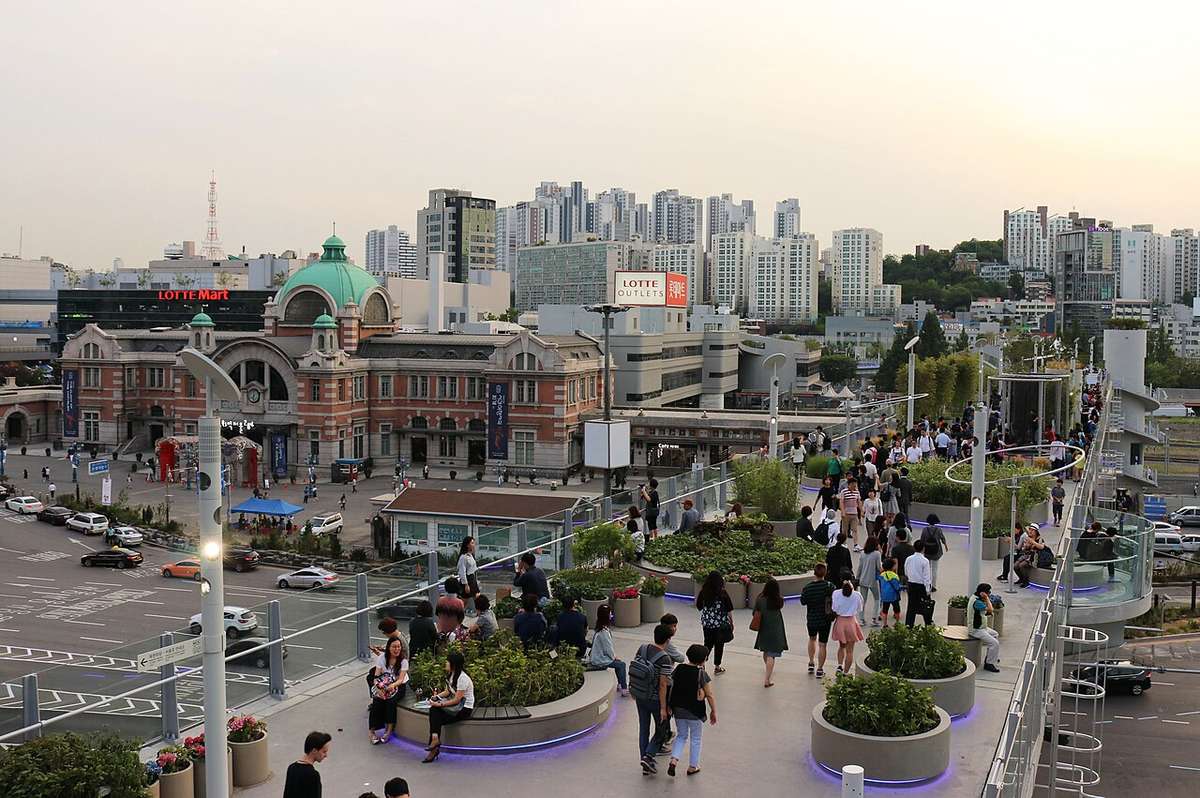
Seoullo 7017 and Old Seoul Station
The 1925 Gyeongseong Station, and a walkway in the sky made from an old road overpass
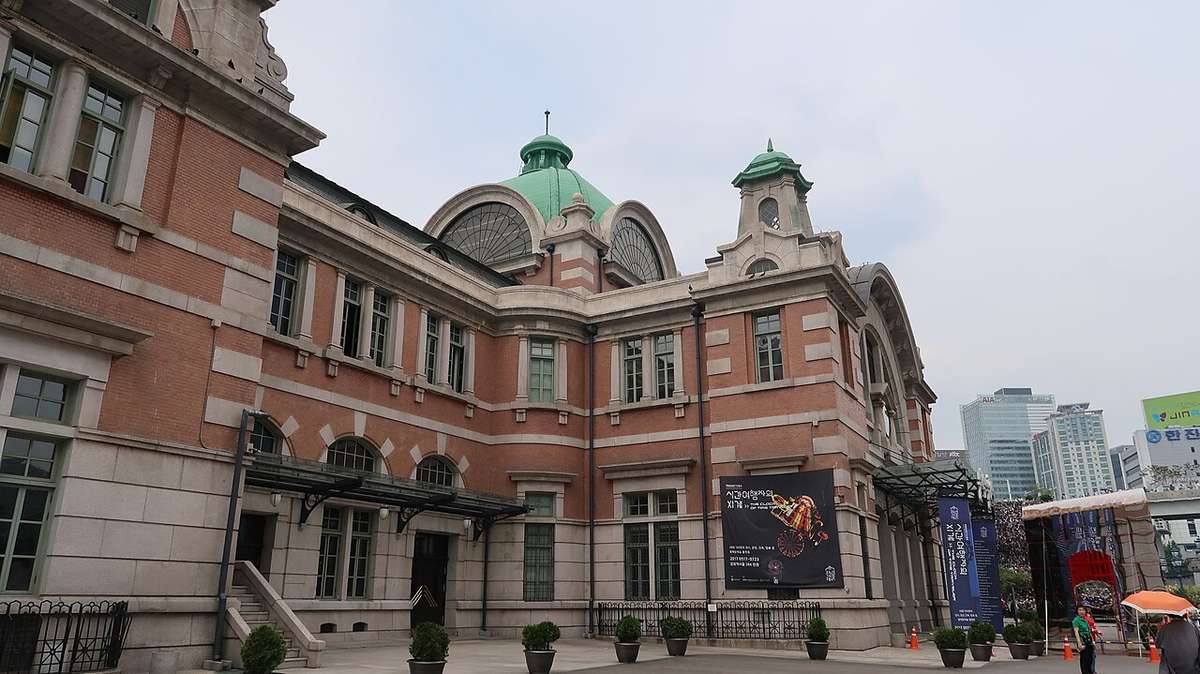
Stand in the Seoul Station plaza and you see a red-brick building topped with a green dome. It is the old Seoul Station, built in 1925 as Gyeongseong Station; for nearly eighty years it was the gateway to Korea's railways, and it is now an exhibition space, Culture Station Seoul 284. Beside it runs Seoullo 7017, a 1970 car overpass remade in 2017 into a path for people. Walk this walkway in the air, lined with planters, and the station's tracks, Sungnyemun Gate and Namsan come into view at once. Since the Airport Railroad stops at Seoul Station, it is often the first place travelers arrive in the city, and they can walk through a century of modern Seoul the moment they get off the train.
📖 The Story
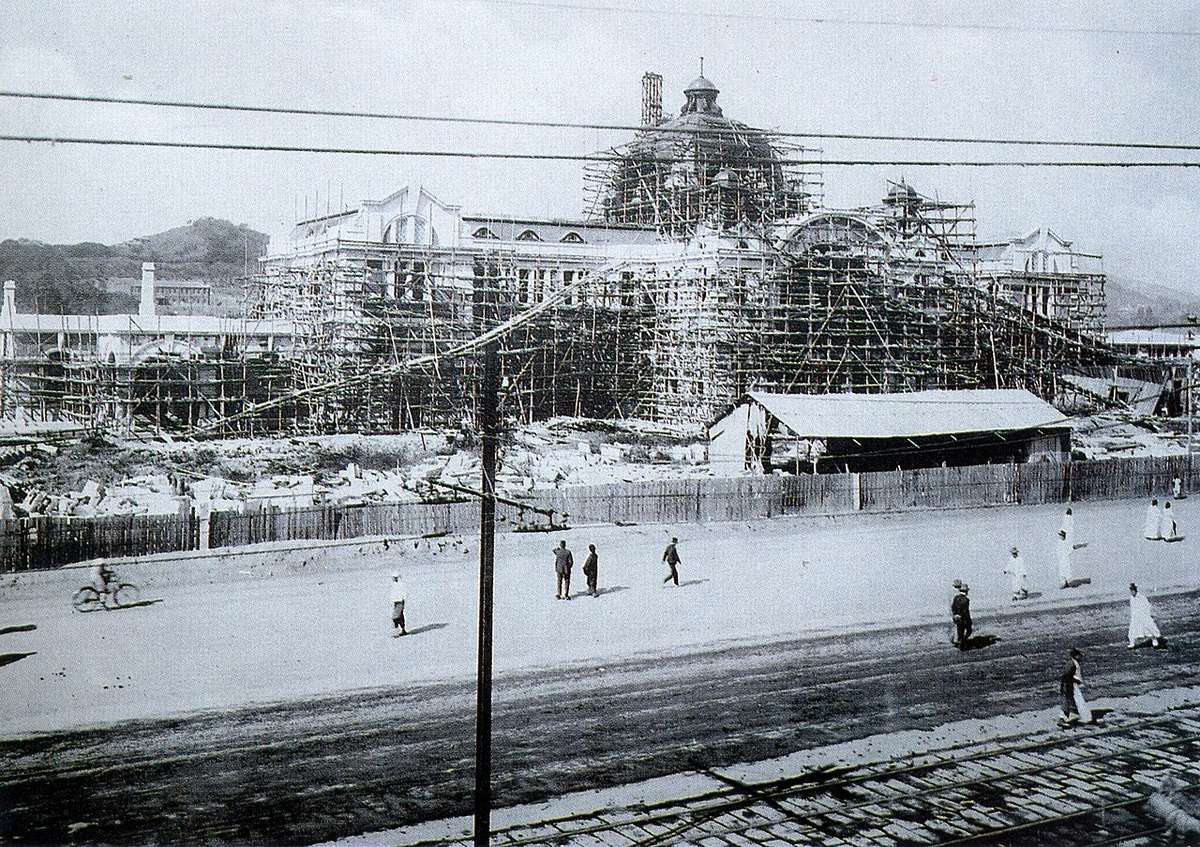
The station on this site began as a small stop opened in 1900. The colonial government decided to build a large new station as the gateway for railways running on to the continent, and work began in 1922. Delayed by the Great Kanto Earthquake of 1923, Gyeongseong Station was finally completed in September 1925. With its red brick, granite and central dome, it was among the most striking Western-style buildings in Seoul at the time. It was renamed Seoul Station in 1947.
Through liberation, war and industrialization, this station became the place where countless people left home for Seoul and went back home for the holidays. When the KTX high-speed rail opened in 2004, the railway functions moved to the new station next door, and the old building, after restoration, opened in 2011 as the arts space Culture Station Seoul 284. The number comes from the building's registration number as a historic site.
The Seoul Station overpass in front of the station opened in 1970 and became a symbol of industrializing Seoul, but over time it aged and became unsafe. Rather than demolish it, the city turned it into a walkway, opening Seoullo 7017 in 2017. The 70 stands for 1970, when the overpass was built, and the 17 for 2017, when it was reborn as a path for people. Side by side, a modern building and an industrial-age overpass that had outlived their uses have both been given a new life.
✦ Highlights
- ›The Seoullo 7017 sky walkwayA walkway in the air made in 2017 from a 1970 car overpass. Planters and gardens run its length, looking down on the station tracks, Sungnyemun and Namsan.
More
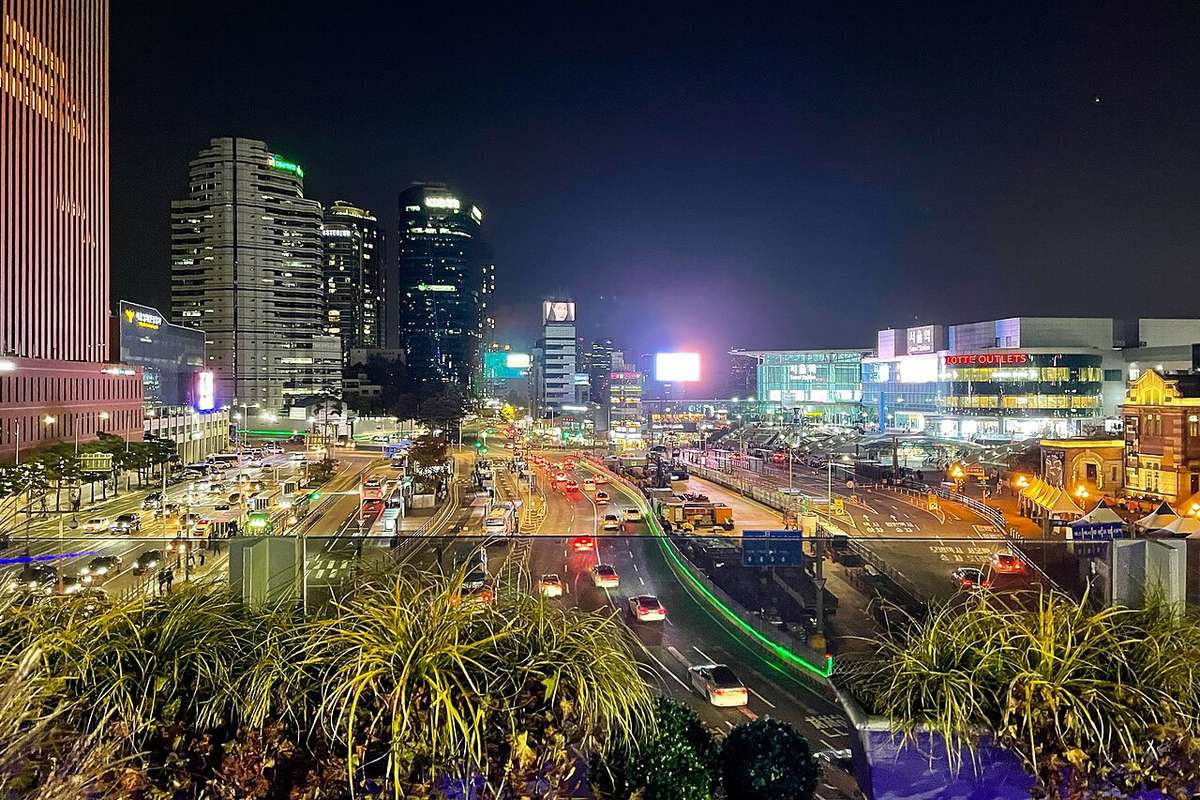
The 70 in the name stands for 1970, when the overpass was built, and the 17 for 2017, when it was reborn as a path for people. More than two hundred species of trees and flowers grow in labeled planters, so the walk is like browsing a plant guide. Crossing the tracks, trains pass beneath your feet, and at night blue lights run along the path, making it a night walk. It connects to Namdaemun Market at the Hoehyeon end and to the neighborhoods west of the station at the Malli-dong end.
- ›Culture Station Seoul 284 (old Seoul Station)The old Seoul Station, built in 1925 as Gyeongseong Station: a red-brick building under a green dome, its waiting hall and VIP room restored as Culture Station Seoul 284, a venue for exhibitions and performances.
More
Delayed by the Great Kanto Earthquake of 1923, it was completed in September 1925, and when the KTX opened in 2004 the railway functions moved to the new station next door. The central hall beneath the dome was the old waiting room, the place where countless people set foot in Seoul for the first time after leaving home. The design was long wrongly attributed to another architect; it is now generally credited to Tsukamoto Yasushi, a professor at Tokyo Imperial University. You can go in only when an exhibition is on, so check the schedule first.
- ›Statue of Kang U-gyuThe statue in the station plaza honoring Kang U-gyu, the independence activist who threw a bomb at the newly arrived Governor-General Saito at this station on 2 September 1919.
More
Kang was over sixty at the time. On the day the new governor-general arrived after the March First Movement, proclaiming "cultural rule", Kang threw a bomb at his party as they were about to board their carriage in front of the station. The assassination failed; he was captured and executed at Seodaemun Prison in 1920. Read this alongside this site's Seodaemun Prison page and you can follow one man's act from the station plaza to the prison's execution building.
- ›Sungnyemun GateThe south gate of the Seoul City Wall, visible from the east end of Seoullo. Built in 1398, it is Seoul's best-known gate, and it stands again after a fire in 2008.
More
A fire in 2008 badly burned its pavilion, and after five years of restoration using traditional methods it reopened in 2013. Of the four great gates, it is the one whose name carries the virtue of propriety, part of the design in which Jeong Do-jeon wrote Confucian virtues into the names of the capital's gates. From the east end of Seoullo you see it standing in the middle of the road, and up close you can see the painted woodwork of the rebuilt pavilion. Namdaemun Market is right next to it.
🚶 Self-Guided Walk
- 1Seoul Station plazaStart with the dome of the old station and the Kang U-gyu statue.
- 2Culture Station Seoul 284If an exhibition is on, step into the old waiting hall.
- 3Seoullo 7017Climb the steps beside the station and walk east along the walkway. Crossing the tracks, trains pass beneath your feet.💡 Walk it at dusk to see it by day and by night.
- 4View of Sungnyemun · Namdaemun MarketSee Sungnyemun from the east end, then descend into Namdaemun Market.
🧭 Visitor Info
💡 Good to Know
- If you have just arrived at Seoul Station on the Airport Railroad, leave your luggage and this makes an easy first walk.
- There is little shade on Seoullo; mornings and evenings are better than a summer midday.
- Culture Station Seoul 284 closes between exhibitions; if you want to see inside, check the schedule first.
🗺 Pair Your Visit
Railways such as the Gyeongin (1899), Gyeongbu (1905) and Gyeongui (1906) lines appear in questions as infrastructure Japan laid or seized for continental aggression and exploitation. In 1919 Kang U-gyu threw a bomb at Governor-General Saito at Namdaemun Station, today's Seoul Station. Sungnyemun, the south gate of the city wall restored after the 2008 fire, also turns up in photo questions on how Seoul changed in the industrial era, alongside the 1970 overpass.